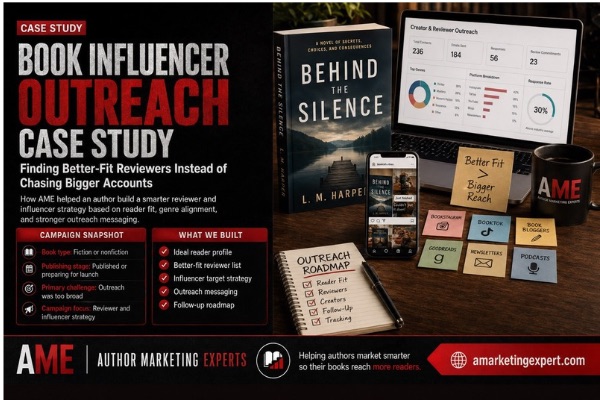
Answer Block: This case study shows how Author Marketing Experts helped an author build a more focused influencer and reviewer outreach strategy around reader fit instead of follower count. The campaign centered on clarifying the book’s ideal readers, identifying better-fit reviewers and influencers, strengthening outreach language, improving reviewer-facing messaging, and creating a more strategic path for book discovery without relying on book-sales claims.
Campaign Snapshot
| Book type | Fiction or nonfiction |
| Genre/category | Withheld for client privacy |
| Publishing stage | Published or preparing for launch or renewed visibility |
| Primary challenge | The author wanted reviewer or influencer attention but was targeting too broadly |
| Campaign focus | Influencer outreach, reviewer strategy, reader targeting, genre fit, outreach messaging |
| Client identity | Withheld at the author’s request |
| Book title | Withheld at the author’s request |
| Campaign type | Influencer and reviewer outreach strategy |
The Book Marketing Challenge
This author came to AME wanting more reviewer and influencer attention.
And that is a very common request.
Authors see books getting talked about on Bookstagram, BookTok, blogs, podcasts, newsletters, Goodreads, and niche reader communities, and they understandably want their book to be part of that conversation.
The problem is that influencer outreach is often misunderstood.
A lot of authors assume the goal is to find the biggest accounts possible and get the book in front of them. The bigger the following, the better the opportunity.
But that is not always true.
A huge account with the wrong audience may do very little for a book. A smaller reviewer with the exact right reader community may be far more valuable. A genre-specific book blogger, a trusted newsletter editor, a niche podcast host, or a highly engaged Bookstagram account can sometimes create more meaningful visibility than a large account that rarely covers books like yours.
That was the issue in this campaign.
The author was thinking about exposure.
We needed to shift the campaign toward fit.
What AME Found
When we reviewed the book, genre, author platform, existing outreach, and target list, we found that the author had been approaching reviewer and influencer outreach too broadly.
Some of the accounts they wanted to reach had large audiences, but those audiences were not necessarily aligned with the book. Some reviewers covered the general category but not the specific subgenre, tone, topic, themes, or reader experience. Some influencers had impressive numbers but low evidence of meaningful engagement with this kind of book.
That matters.
Influencer outreach is not just about visibility. It is about reader trust.
A strong reviewer or influencer has built a relationship with a specific audience. Their followers are paying attention because they trust that person’s taste, recommendations, tone, and point of view.
If the book does not fit that trust relationship, the outreach is unlikely to land.
We also found that the author’s outreach language was too author-centered. It focused heavily on the book itself, but it did not clearly explain why the reviewer’s specific audience might care.
That became the core problem to solve.
The Strategy
Our strategy was to build an outreach plan around relevance rather than reach.
That meant focusing on five core areas:
- Clarifying the book’s ideal reader and discovery path
- Identifying the best-fit reviewer and influencer categories
- Evaluating potential outreach targets based on audience alignment, not just audience size
- Strengthening the reviewer-facing pitch language
- Creating a practical outreach roadmap the author could use without sounding generic or transactional
The goal was not to get the book in front of everyone.
The goal was to get the book in front of people whose audiences were already likely to care.
That is a very different campaign.
And for reviewer and influencer outreach, it is usually the smarter one.
Campaign Components
1. Reader-Fit Review
We started by clarifying the book’s ideal reader.
This step matters because influencer outreach should not begin with the influencer.
It should begin with the reader.
For fiction, we looked at genre, subgenre, tropes, emotional promise, tone, pacing, comparable authors, setting, themes, and reader expectations.
For nonfiction, we looked at the reader problem, topic relevance, practical takeaway, author credibility, audience need, and the communities already interested in that conversation.
The key question was:
Who would genuinely be glad this book was recommended to them?
Once that reader became clearer, the outreach strategy became much easier to build.
2. Reviewer and Influencer Mapping
Next, we mapped the types of reviewers and influencers most likely to be a fit.
Depending on the book, this could include:
- Bookstagram reviewers
- BookTok creators
- Book bloggers
- Goodreads reviewers
- Newsletter editors
- Podcast hosts
- Genre-specific reviewers
- Niche-topic influencers
- Library or bookstore influencers
- Book-club leaders
- Reader-community moderators
- Substack writers
- YouTube reviewers
- Local or regional book influencers
- Professional or topic-specific influencers for nonfiction
- Comparable-author reader communities
The point was not to create the longest possible list.
The point was to create a useful list.
A good outreach list should help the author avoid wasting time on reviewers who rarely cover the category, do not accept submissions, prefer a different format, are inactive, have no visible engagement, or consistently review books with a different reader promise.
For this campaign, we narrowed the outreach universe to the people and platforms that made the most sense for the book.
3. Quality and Fit Evaluation
Then we evaluated possible outreach targets based on fit.
This is where many authors get distracted by vanity metrics.
Follower count can matter, but it is not the whole story. In many cases, it is not even the most important part.
We looked at factors such as:
- Does this person review books in this genre or topic area?
- Do they appear to have real engagement?
- Do their followers comment meaningfully?
- Do they post consistently?
- Do they accept review copies?
- Do they prefer print, ebook, or audio?
- Do they feature traditionally published, indie, hybrid, or self-published books?
- Do they disclose review policies?
- Do their captions or reviews show thoughtful reader alignment?
- Does the book fit their taste and audience?
- Would this pitch feel relevant to them, or random?
That last question matters.
If the pitch feels random, the campaign is already in trouble.
4. Reviewer-Facing Messaging
Once we clarified the outreach targets, we refined the pitch language.
Reviewer and influencer outreach should not feel like a mass request for free promotion. It should feel relevant, respectful, and easy to evaluate.
For this campaign, we developed outreach language that clearly explained:
- What kind of book it was
- Who the book was likely to appeal to
- Why it might fit that reviewer’s audience
- What format was available
- What made the book timely, distinctive, useful, or appealing
- What the author was asking for
- Why the outreach was specific to that reviewer or community
The revised messaging was more reader-focused and less promotional.
That distinction is important.
A reviewer is not there to serve the author’s marketing plan. They are there to serve their own audience.
The pitch has to respect that.
5. Outreach Roadmap and Follow-Up Strategy
Finally, we created a practical outreach roadmap.
This included:
- Which reviewer and influencer categories to prioritize
- Which outreach targets were highest fit
- Which materials needed to be prepared
- How to personalize outreach without overcomplicating it
- How to track responses
- How to follow up appropriately
- How to avoid over-contacting people
- How to turn positive responses into reusable visibility assets
- How to use reviewer feedback, quotes, images, and links where appropriate
- How to continue outreach beyond one campaign window
The goal was to give the author a strategy they could actually use.
Influencer outreach can get messy quickly if there is no system. Authors lose track of who they contacted, what they sent, who responded, who declined, who requested a copy, and who eventually posted.
A good outreach roadmap protects both the campaign and the author’s reputation.
What Changed
Before the Campaign
Before the campaign, the author was approaching influencer and reviewer outreach too broadly.
They were interested in visibility, but the target list was not focused enough. The outreach language did not clearly explain why the book was a fit for specific reviewers or communities. The author was giving too much weight to audience size and not enough weight to reader alignment.
The book had potential for reviewer visibility, but the outreach strategy needed more precision.
After the Campaign
After the campaign, the author had a clearer, more focused reviewer and influencer strategy.
The ideal reader was better defined. The outreach list became more relevant. The reviewer-facing messaging was stronger. The author better understood which accounts, blogs, newsletters, podcasts, and reader communities were worth prioritizing.
Most importantly, the campaign shifted from:
Who has the biggest audience?
to:
Whose audience is most likely to care about this book?
That is the better question.
Campaign Outcomes and Progress Markers
Because we do not use case studies to make book-sales promises, the outcomes we focus on are the pieces of the campaign that improved reader alignment, outreach quality, and long-term visibility strategy.
For this campaign, those included:
- A clearer ideal-reader profile
- A more focused reviewer and influencer target strategy
- Better understanding of genre, topic, trope, or reader-community fit
- A stronger outreach list based on relevance rather than follower count
- Improved reviewer-facing pitch language
- Clearer book description and talking points for outreach
- Better tracking and follow-up recommendations
- Reduced wasted outreach to poor-fit accounts
- Stronger alignment between the book and the communities most likely to respond
- A more respectful, sustainable approach to influencer and reviewer relationships
These outcomes matter because reviewer and influencer outreach is not just about getting attention.
It is about finding the right people who can introduce the book to the right readers.
What This Campaign Demonstrates
This campaign demonstrates one of the biggest misconceptions in book influencer outreach:
Bigger is not always better.
Better fit is better.
A smaller reviewer who consistently talks to the exact right readers can be more valuable than a large influencer whose audience is not aligned with the book. A niche blog with loyal genre readers can be more useful than a general account that accepts everything. A thoughtful podcast or newsletter can create stronger context than a quick post from someone who rarely covers books like yours.
Influencer outreach works best when the author understands that reviewers and creators are not just promotional channels.
They are audience curators.
Their credibility depends on recommending books that make sense for their readers and followers.
That is why fit matters so much.
What Other Authors Can Learn From This
If you are considering influencer or reviewer outreach, do not start with follower count.
Start with reader alignment.
Before you send review requests, ask yourself:
- Who is my ideal reader?
- Which reviewers already speak to that reader?
- Does this influencer actually cover books like mine?
- Is their audience engaged, or just large?
- Do they accept books in my format?
- Have I read their review policy?
- Does my pitch explain why the book fits their audience?
- Am I personalizing the outreach in a meaningful way?
- Is my book page ready if someone clicks through?
- Do I have a system for tracking outreach and follow-up?
Reviewer outreach is not about pushing your book at strangers.
It is about finding the right reader pathways and approaching them with relevance and respect.
Is This Similar to Your Situation?
This kind of campaign may be a fit if:
- You want more reviewer or influencer attention for your book
- You are not sure which reviewers or influencers are actually a fit
- You have been chasing larger accounts without much response
- Your outreach emails feel generic
- You do not know how to identify better-fit Bookstagram, BookTok, blog, podcast, newsletter, or Goodreads opportunities
- Your book has strong reader appeal, but you are not sure how to communicate it
- You want to stop wasting copies on poor-fit outreach
- You need help building a more useful reviewer target list
- You want a smarter way to approach influencers before launch, relaunch, or renewed visibility
- You want outreach that feels professional, relevant, and respectful
This is not about chasing attention.
It is about finding the right reader bridges.
The AME Campaign Lesson
The best influencer for your book is not always the person with the biggest audience.
It is the person whose audience is most likely to trust, understand, and care about the recommendation.
Frequently Asked Questions
What is book influencer outreach?
Book influencer outreach is the process of identifying and approaching reviewers, creators, bloggers, podcasters, newsletter editors, Bookstagrammers, BookTok creators, Goodreads reviewers, and other reader-community leaders who may be a good fit for a specific book.
Is influencer outreach only for fiction authors?
No. Fiction authors often use influencer outreach to reach genre-specific readers, but nonfiction authors can also benefit. For nonfiction, the best-fit influencers may be topic experts, podcast hosts, newsletter writers, professional communities, industry voices, educators, advocates, or niche content creators.
Should authors only target influencers with large followings?
No. Follower count is only one factor. Audience fit, engagement, genre alignment, review quality, consistency, trust, and relevance often matter more. A smaller reviewer with a highly aligned audience can be more useful than a larger account with the wrong followers.
What should an author include in a reviewer pitch?
A reviewer pitch should clearly explain what the book is, who it is for, why it may fit the reviewer’s audience, what format is available, and what the author is requesting. The pitch should also show that the author has reviewed the person’s content or submission guidelines.
Can AME guarantee reviews or influencer posts?
No. AME does not guarantee reviews, influencer posts, media placements, book sales, bestseller status, or specific commercial outcomes. Reviewer and influencer outreach depends on fit, timing, availability, reviewer interest, submission policies, format preferences, and many other factors outside the control of any marketing agency.
Why are the author name and book title not included?
Some authors prefer to keep the internal details of their marketing campaigns private. To respect client confidentiality, we may withhold the author’s name, book title, and certain identifying details. The campaign strategy, challenges, and outcomes described here are based on real client work.
Check Out All of Our Book Marketing Case Studies:
- Amazon Book Optimization Case Study: Retail Pages for Authors
- Pre-Publication Book Marketing Case Study: Launch Readiness
- Book Marketing Strategy Case Study: Campaign Pivot & Readiness
- Book Publicity Case Study: Media Angles & Author Visibility
- Book Relaunch Case Study: Renewed Visibility Strategy for Authors
- Fiction Book Marketing Case Study: Amazon & Retail Optimization
- Nonfiction Book Marketing Case Study: Author Platform & Visibility
- Local Book Marketing Case Study: Turning a Book Into a Local Visibility Opportunity
Ready to Find Better-Fit Reviewers and Influencers?
If you are sending books or pitches to people who are not really aligned with your audience, your outreach may be working harder than it should.
Author Marketing Experts helps serious authors clarify their reader fit, identify more relevant reviewers and influencers, improve outreach messaging, and build a strategy around the communities most likely to care.
If you are ready to stop chasing bigger accounts and start building smarter reader pathways, apply for a book marketing strategy consultation.
0 Comments