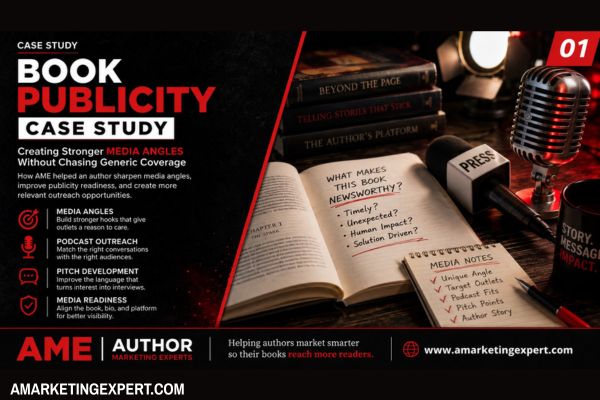
This case study shows how Author Marketing Experts helped an author move from a generic “please cover my book” publicity approach to a stronger, more relevant media strategy. The campaign focused on identifying timely angles, clarifying the author’s expertise, building audience-specific pitch ideas, improving media readiness, and creating outreach opportunities that gave podcast hosts, journalists, bloggers, and community platforms a better reason to care.
Campaign Snapshot
- Book type: Fiction or nonfiction
- Genre/category: Withheld for client privacy
- Publishing stage: Published or preparing for renewed visibility
- Primary challenge: The author wanted publicity, but the book did not yet have a clear media angle
- Campaign focus: Publicity strategy, media angles, podcast outreach, author positioning, pitch development
- Client identity: Withheld at the author’s request
- Book title: Withheld at the author’s request
- Campaign type: Media-readiness and publicity-angle development
The Book Marketing Challenge
This author came to AME wanting publicity.
That is something we hear all the time.
Authors want media coverage. They want podcast interviews. They want articles. They want bloggers, journalists, influencers, local outlets, and reader-facing platforms to pay attention to their book.
And that makes sense.
Publicity can be a powerful part of a book marketing campaign. But publicity only works when there is a reason for someone else’s audience to care.
That was the challenge here.
The author had a book they believed in, but the initial pitch was too focused on the fact that the book existed. The campaign language was built around the announcement: the book was available, the author had written it, and people should know about it.
But “I wrote a book” is rarely enough of a media angle.
Media contacts, podcast hosts, newsletter editors, bloggers, local reporters, and community platforms are not usually looking for book announcements. They are looking for useful conversations, timely insights, compelling stories, audience relevance, expert commentary, emotional hooks, local connections, practical takeaways, or topics that fit the conversations they are already having.
The author did not need to chase more coverage.
They needed stronger angles.
What AME Found
When we reviewed the book, author background, platform, existing outreach language, and target audiences, we found that there were legitimate publicity opportunities.
But they were buried.
The book had themes that could connect to current conversations. The author had a personal or professional point of view that made the message more credible. There were audiences who would care about the topic, story, category, or emotional hook. But the campaign was not yet translating those pieces into media-friendly angles.
This is one of the most common publicity problems authors have.
They are too close to the book.
They describe what the book is about instead of explaining why the topic matters now. They focus on the publication date instead of the conversation. They pitch the book instead of the value the author can bring to an audience.
For publicity, that distinction matters.
A book is the credential. The angle is the invitation.
The campaign needed to move from “here is my book” to “here is a timely, relevant, useful conversation this author can lead.”
The Strategy
Our strategy was to make the author and book more media-ready by building a stronger publicity framework.
That meant focusing on five core areas:
- Identifying the most relevant audiences for the book
- Clarifying the author’s credibility and point of view
- Developing timely, specific, audience-centered media angles
- Creating stronger pitch language for podcasts, media, blogs, local outlets, and community platforms
- Building a publicity plan that prioritized relevance over volume
This was not about blasting the book to every outlet we could find.
That is rarely a good strategy.
The goal was to create pitch angles that made sense for the book, the author, the audience, and the outlet.
Good publicity does not begin with the question, “Who can we send this to?”
It begins with, “Why would this audience care?”
Campaign Components
1. Publicity Readiness Review
We started by reviewing whether the author was ready for publicity.
This included looking at:
- Author bio
- Book description
- Author website
- Media kit or press materials
- Podcast topics
- Speaking topics
- Retail-page presentation
- Relevant credentials
- Personal or professional story
- Audience fit
- Existing outreach language
- Timeliness of the book’s topic or themes
Publicity works best when the author’s public-facing materials support the pitch.
If a podcast host receives a strong pitch but then visits a website that does not reinforce the author’s credibility, the opportunity can weaken quickly. If a journalist sees an interesting topic but the author bio is vague, the campaign loses momentum. If the book page does not clearly support the angle, the story becomes harder to place.
In this case, the author had enough substance to support publicity, but the materials needed stronger alignment.
2. Audience and Outlet Mapping
Next, we identified the audiences most likely to care about the book.
Not all publicity is equal.
A huge outlet that reaches the wrong audience may be less valuable than a smaller podcast, newsletter, blog, local outlet, industry platform, or community resource with a highly engaged audience.
We mapped the campaign around audience fit.
Depending on the book, that may include:
- Podcast audiences
- Local or regional readers
- Industry groups
- Professional associations
- Book clubs
- Community organizations
- Niche blogs
- Reader communities
- Topic-specific newsletters
- Book influencers
- Lifestyle media
- Trade or specialty publications
- Libraries, bookstores, or event partners
The goal was not to make the list as big as possible.
The goal was to make it more relevant.
3. Media Angle Development
This was the heart of the campaign.
We developed multiple pitch angles that gave the author more than one way into a conversation.
A strong media angle might connect to:
- A timely issue
- A seasonal moment
- A cultural trend
- A common reader problem
- A misunderstood topic
- A personal story
- A professional insight
- A local connection
- A community need
- A holiday or awareness month
- A provocative question
- A useful framework
- A practical takeaway
- A surprising lesson from the book
For nonfiction, this often means turning the book’s expertise into interviews, articles, tips, commentary, or thought-leadership topics.
For fiction, this may mean connecting the book’s themes, setting, character journey, genre appeal, local ties, historical backdrop, social issues, reader communities, or emotional hook to a broader conversation.
The important thing is that the angle gives the outlet a reason to say yes.
Not because the author wants coverage.
Because the audience gets something useful, interesting, timely, or relevant.
4. Pitch Language and Messaging
Once we identified the strongest angles, we turned them into usable pitch language.
This included developing clearer ways to introduce the author, frame the book, and explain the value of the conversation.
A good pitch should make the recipient’s job easier.
It should quickly answer:
- Who is this author?
- Why are they credible?
- What is the topic?
- Why does it matter now?
- Why would my audience care?
- What can the author talk about?
- What makes this different from every other book pitch?
The author’s original pitch was too book-centered. The revised pitch language was more audience-centered.
That shift matters.
Instead of saying, “This author has a new book,” the pitch began to frame the author as someone who could bring insight, perspective, story, or useful conversation to a specific audience.
5. Outreach Prioritization
Finally, we helped prioritize the outreach plan.
This is where a lot of publicity campaigns go wrong.
Authors often assume that more outreach automatically means better publicity. But if the pitch is not relevant, more outreach can simply create more ignored emails.
For this campaign, we focused on the outlets and opportunities most aligned with the book’s message, the author’s credibility, and the intended audience.
That gave the author a more strategic path forward.
The campaign was no longer about chasing publicity anywhere.
It was about pursuing visibility where the author and book had a legitimate reason to show up.
What Changed
Before the Campaign
Before the campaign, the author wanted publicity but did not have strong enough angles to support the outreach.
The messaging was too focused on the book announcement. The author’s value to an outside audience was not clear enough. The pitch did not fully explain why the topic mattered now, why the author was credible, or why a host, reporter, blogger, or platform should care.
The book had publicity potential, but the campaign needed stronger framing.
After the Campaign
After the campaign, the author had a clearer publicity strategy and stronger outreach language.
The campaign was built around specific angles, audiences, and opportunities. The author’s credibility was easier to understand. The book was connected to larger conversations. The pitch language gave media contacts and podcast hosts a better reason to consider the author.
Most importantly, the author stopped pitching the book as the whole story.
The book became the doorway into a better conversation.
That is how publicity gets stronger.
Campaign Outcomes and Progress Markers
Because we do not use case studies to make book-sales promises, the outcomes we focus on are the pieces of the campaign that improved the author’s media readiness, pitch quality, and visibility strategy.
For this campaign, those included:
- A clearer publicity position for the book
- More specific audience and outlet targeting
- Stronger author bio and media-facing language
- Multiple audience-specific pitch angles
- Improved podcast and media topic development
- A stronger connection between the book and timely conversations
- A more relevant outreach list
- Better alignment between the author’s website, book page, and pitch language
- A campaign strategy based on relevance instead of volume
- A clearer path for pursuing publicity beyond launch week
These are the pieces that make publicity more focused, more credible, and more useful.
What This Campaign Demonstrates
This campaign demonstrates one of the most important truths about book publicity:
The book is not always the story.
Sometimes the story is the author’s expertise. Sometimes it is the issue the book addresses. Sometimes it is the personal journey behind the book. Sometimes it is the cultural conversation around the topic. Sometimes it is the local connection, the reader takeaway, the surprising lesson, or the practical framework the author can share.
Authors often come to publicity thinking the pitch is:
“Please feature my book.”
But the stronger pitch is usually:
“Here is a conversation your audience will care about, and here is why this author is the right person to have it.”
That is a very different approach.
And it is much more effective.
What Other Authors Can Learn From This
If you want publicity for your book, start by looking beyond the book announcement.
Ask yourself:
- Why would a podcast host want this conversation?
- What can I teach, explain, reveal, challenge, or clarify?
- What timely topic does my book connect to?
- What audience needs this message?
- What makes my perspective credible?
- What would make someone say, “This is useful for my readers or listeners”?
- Am I pitching the book, or am I pitching a conversation?
- Do my website, bio, and book page support the pitch?
- Do I have more than one angle?
- Am I targeting the right outlets, or just the biggest ones?
Publicity is not about asking the world to care about your book.
It is about showing the right audience why the conversation matters.
Is This Similar to Your Situation?
This kind of campaign may be a fit if:
- You want podcast interviews, media coverage, blog features, or local visibility
- You are not sure what your strongest publicity angle is
- You have been pitching your book but getting little response
- Your outreach language feels too generic
- You know your book has a meaningful message, but you are not sure how to package it
- You need stronger media, podcast, or speaking topics
- Your author bio or website does not fully support your credibility
- You want to stop sending broad pitches and start targeting better-fit opportunities
- You need help connecting your book to timely, relevant conversations
- You want publicity that supports long-term visibility, not just launch-week attention
This is not about making noise.
It is about giving the right outlets a reason to listen.
Frequently Asked Questions
What is a book publicity angle?
A book publicity angle is the reason a media outlet, podcast host, blogger, journalist, community platform, or audience might care about your book or message. It usually goes beyond the fact that the book exists. A strong angle connects the author, book, topic, audience, and timing in a way that creates a useful or interesting conversation.
Why is “I wrote a book” not enough for publicity?
Because media contacts and podcast hosts are usually not looking for book announcements. They are looking for stories, insights, expert commentary, timely topics, audience value, and compelling conversations. The book can support the pitch, but the angle is what makes the pitch relevant.
Can fiction authors use publicity angles too?
Yes. Fiction authors can build publicity angles around themes, setting, local connections, historical context, genre trends, character issues, personal inspiration, community relevance, seasonal tie-ins, or the emotional questions the book explores. Fiction publicity is often more challenging than nonfiction publicity, but strong angles can help.
What kinds of outlets are best for book publicity?
The best outlets are the ones that fit the book’s audience and message. That may include podcasts, local media, niche blogs, newsletters, book influencers, trade outlets, community organizations, professional associations, libraries, bookstores, or topic-specific platforms.
Bigger is not always better. Relevance matters.
Does AME guarantee media coverage?
No. AME does not guarantee media coverage, podcast bookings, reviews, book sales, bestseller status, or specific commercial outcomes. Publicity depends on timing, outlet interest, audience fit, newsworthiness, author credentials, responsiveness, and many other factors outside the control of any marketing agency.
Why are the author name and book title not included?
Some authors prefer to keep the internal details of their marketing campaigns private. To respect client confidentiality, we may withhold the author’s name, book title, and certain identifying details. The campaign strategy, challenges, and outcomes described here are based on real client work.
Check Out All of Our Book Marketing Case Studies
- Amazon Book Optimization Case Study: Retail Pages for Authors
- Pre-Publication Book Marketing Case Study: Launch Readiness
- Book Influencer Outreach Case Study: Finding Better-Fit Reviewers Instead of Chasing Bigger Accounts
- Book Marketing Strategy Case Study: Campaign Pivot & Readiness
- Book Relaunch Case Study: Renewed Visibility Strategy for Authors
- Fiction Book Marketing Case Study: Amazon & Retail Optimization
- Nonfiction Book Marketing Case Study: Author Platform & Visibility
- Local Book Marketing Case Study: Turning a Book Into a Local Visibility Opportunity
Ready to Build a Stronger Publicity Strategy?
If you want publicity for your book, the first step is not sending more pitches.
It is building a better reason for someone to say yes.
Author Marketing Experts helps serious authors clarify their strongest angles, improve media readiness, identify relevant visibility opportunities, and build publicity strategies that are rooted in audience fit rather than generic outreach.
If you are ready to stop chasing coverage and start building a smarter publicity strategy, apply for a book marketing strategy consultation.
If this case study sounds familiar, these resources may also be helpful:
Book Marketing Services
Fiction Book Marketing Services
Nonfiction Book Promotion Services
Author Platform Development
How to Build Better Book Publicity Angles
How to Pitch Podcasts as an Author
How to Get Media Attention for Your Book
Ready to Build a Stronger Publicity Strategy?
If you want publicity for your book, the first step is not sending more pitches.
It is building a better reason for someone to say yes.
Author Marketing Experts helps serious authors clarify their strongest angles, improve media readiness, identify relevant visibility opportunities, and build publicity strategies that are rooted in audience fit rather than generic outreach.
If you are ready to stop chasing coverage and start building a smarter publicity strategy, contact us today.
0 Comments