
Answer Block
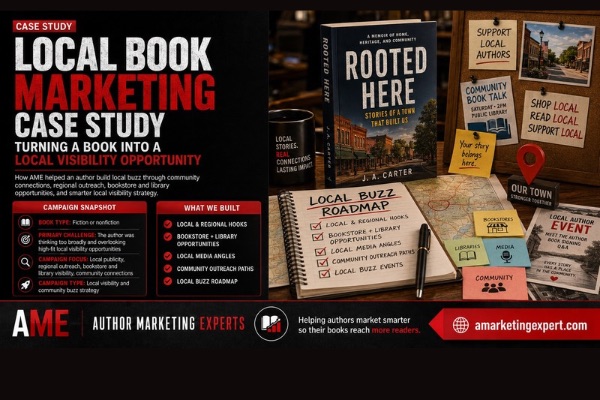
This case study shows how Author Marketing Experts helped an author build a stronger local and regional visibility strategy around their book. The campaign focused on identifying community connections, local media angles, bookstore and library opportunities, regional outreach paths, and author-specific visibility hooks that made the book more relevant close to home before trying to chase broader attention.
Campaign Snapshot
- Book type: Fiction or nonfiction
- Genre/category: Withheld for client privacy
- Publishing stage: Published or preparing for renewed visibility
- Primary challenge: The author was thinking too broadly and overlooking high-fit local visibility opportunities
- Campaign focus: Local publicity, regional outreach, bookstore and library visibility, community connections, author positioning
- Client identity: Withheld at the author’s request
- Book title: Withheld at the author’s request
- Campaign type: Local visibility and community buzz strategy
The Book Marketing Challenge
This author came to AME wanting more visibility for their book.
Like a lot of authors, they were thinking big.
They wanted national attention. They wanted media. They wanted more readers. They wanted to know how to get the book in front of people beyond their immediate circle.
That instinct makes sense.
But one of the biggest mistakes authors make is assuming that “bigger” is always better.
Sometimes the smartest visibility starts closer to home.
Local and regional marketing can be incredibly powerful for authors because it gives the campaign something national outreach often lacks: a real connection.
A local bookstore may care that the author lives nearby. A regional podcast may care about a book tied to the community. A library may care about a local author program. A hometown newspaper may care about an author with a relevant story, expertise, or local angle.
A civic group, professional association, book club, school, nonprofit, or community organization may care because the author’s topic or story connects to people they already serve.
That was the opportunity in this campaign.
The author did not need to abandon broader visibility.
They needed to build a smarter local foundation first.
What AME Found
When we reviewed the book, author background, platform, location, genre, message, and existing outreach, we found that the author had more local opportunities than they realized.
But those opportunities were not being packaged clearly.
The author was talking about the book in general terms. They were focused on what the book was about, why they wrote it, and where they hoped it might go. But they had not fully developed the local and regional angles that could make the book easier to pitch, host, feature, or recommend.
This is very common.
Authors often assume local visibility only matters if the book is explicitly set in their town or directly about a local issue. That helps, of course. But it is not the only path.
A local angle can come from many places:
- Where the author lives
- Where the author grew up
- Where the book is set
- Where the author works
- Where the author teaches, speaks, volunteers, or serves
- A local business, nonprofit, school, faith community, or professional group connection
- A regional issue tied to the book’s topic
- A local event, anniversary, season, or community conversation
- The author’s expertise or lived experience
- The book’s usefulness to a specific local audience
- The author’s ability to give a talk, workshop, reading, or discussion
The author had several of these possibilities, but the campaign needed to turn them into a clear local visibility strategy.
The Strategy
Our strategy was to identify where the book, author, and community naturally intersected.
That meant focusing on five core areas:
- Clarifying the strongest local and regional hooks
- Mapping high-fit community opportunities
- Developing local media, bookstore, library, and organization outreach angles
- Creating reusable pitch language for regional visibility
- Building a practical local visibility roadmap the author could continue using beyond the campaign
The goal was not to make the campaign feel small.
The goal was to make it more relevant.
Because local marketing is not a consolation prize.
It can create credibility, word-of-mouth, event opportunities, media mentions, community partnerships, content, photos, testimonials, speaking experience, bookstore relationships, library connections, and momentum the author can build on.
A strong local campaign can become the proof of concept for broader visibility.
Campaign Components
1. Local Visibility Audit
We began by reviewing the author’s existing local footprint.
This included looking at:
- Author location
- Book setting, if relevant
- Author bio
- Website
- Social presence
- Professional background
- Community ties
- Prior events or speaking experience
- Local media possibilities
- Library and bookstore opportunities
- Regional organizations
- Reader or topic communities
- Possible local partnerships
- Seasonal or event-based hooks
The goal was to identify what could make the author more visible in their own region.
Not every author has the same local assets. Some have deep community connections. Others are newer to an area. Some have a book that naturally fits local events or regional media. Others need a more creative bridge between the book and the community.
For this campaign, we found several opportunities that had not been fully explored.
2. Local and Regional Angle Development
Next, we developed the author’s local angles.
This was the most important part of the campaign.
A local pitch should not simply say:
“I am a local author and I wrote a book.”
That can work occasionally, but it is usually not strong enough by itself.
The better pitch answers:
- Why this book?
- Why this author?
- Why this community?
- Why now?
- Why would a local audience care?
For this author, we developed angles that connected the book to the author’s background, the community, the reader audience, and potential local conversations.
Depending on the book, those angles may include:
- A local author story
- A regional setting or hometown connection
- A topic relevant to local readers
- A community issue or conversation
- A book-club or library discussion theme
- A workshop or educational event
- A local business or professional tie-in
- A school, university, faith, civic, or nonprofit connection
- A seasonal or holiday tie-in
- A regional media feature angle
- A local “author returns home” or “author gives back” angle
- A book launch or relaunch event with community relevance
The strongest local visibility happens when the outreach gives people a reason to care beyond the fact that the book exists.
3. Bookstore and Library Opportunity Mapping
We also looked at bookstore and library opportunities.
Authors often approach bookstores and libraries too broadly. They ask for an event, a signing, or shelf space without thinking through why that location should say yes.
A stronger approach considers fit.
For bookstores, that might include:
- Genre alignment
- Local author programs
- Event history
- Community audience
- Independent bookstore priorities
- Book-club programming
- Regional interest
- Store size and event capacity
- Relevant partner organizations
- Timing and promotional support
For libraries, that might include:
- Author talks
- Book-club discussions
- Local author showcases
- Writing workshops
- Topic-specific programming
- Community education
- Historical or regional relevance
- Teen, adult, senior, or professional programming
- Summer reading or seasonal events
- Partnerships with Friends of the Library groups
For this campaign, we identified better-fit local and regional bookstore, library, and community-programming opportunities rather than encouraging the author to send generic event requests everywhere.
4. Local Media and Community Outreach
Local media can still matter, but the pitch has to be relevant.
A local reporter, radio host, podcast host, newsletter editor, or community publication is not just looking for a book announcement. They are looking for a local story, useful topic, timely conversation, or community connection.
For this author, we created more targeted outreach language for local and regional visibility.
This included pitch directions for:
- Local newspapers
- Regional magazines
- Community newsletters
- Local podcasts
- Radio segments
- TV lifestyle segments, where appropriate
- Neighborhood publications
- Professional association newsletters
- Civic groups
- Nonprofits
- Schools, universities, or alumni outlets
- Faith communities, if relevant
- Business organizations
- Chambers of commerce
- Topic-specific local groups
The campaign was not built around chasing every possible media contact.
It was built around identifying the places where the book and author had a real reason to show up.
5. Community Buzz Roadmap
Finally, we created a practical local visibility roadmap.
This gave the author a sequence rather than a scattered list of ideas.
The roadmap included:
- Which local opportunities to prioritize first
- Which outreach angles to use for each group
- Which materials needed to be prepared
- Which events or seasonal windows mattered
- Which bookstores, libraries, organizations, or media outlets were highest fit
- How to follow up without sounding pushy
- How to turn one local opportunity into another
- How to capture photos, links, quotes, and proof points
- How to keep local visibility going after the first outreach push
That last point matters.
Local visibility works best when it compounds.
One library talk can lead to another. One local article can support a bookstore pitch. One bookstore event can create social proof for a regional festival. One podcast interview can become content for the author’s website. One community partnership can create a speaking opportunity.
The goal was to help the author see local marketing not as a one-time task, but as a visibility ecosystem.
What Changed
Before the Campaign
Before the campaign, the author was thinking about visibility in broad terms.
They wanted more attention but had not fully identified the local and regional opportunities that could give the book a more relevant path into the market.
The author’s outreach language was too general. The local hooks were underdeveloped. Bookstore, library, media, and community opportunities had not been prioritized strategically.
The author had potential local visibility assets, but they were not yet organized into a campaign.
After the Campaign
After the campaign, the author had a clearer local visibility strategy.
The local angles were stronger. The outreach opportunities were more specific. The bookstore, library, media, and community targets were better aligned with the book and author. The pitch language gave local contacts a more compelling reason to consider the author.
Most importantly, the author stopped seeing local marketing as “small.”
They began seeing it as a smart, strategic way to build credibility, connection, and momentum.
That shift matters.
Campaign Outcomes and Progress Markers
Because we do not use case studies to make book-sales promises, the outcomes we focus on are the pieces of the campaign that improved the author’s visibility foundation, local relevance, and outreach strategy.
For this campaign, those included:
- A clearer local and regional visibility position
- Stronger community-specific pitch angles
- A more focused list of local media, podcast, bookstore, library, and organization opportunities
- Better alignment between the author’s background, book topic, and regional audience
- Reusable outreach language for local contacts
- A more strategic bookstore and library approach
- A practical community buzz roadmap
- Clearer event, speaking, or discussion opportunities
- A stronger plan for turning local visibility into longer-term momentum
- A better understanding of how local marketing can support broader author visibility
These outcomes matter because local visibility can give a book something broad promotion often cannot: context.
When a community understands why the author and book are relevant, the campaign becomes easier to support, share, host, and talk about.
What This Campaign Demonstrates
This campaign demonstrates one of the most overlooked truths in book marketing:
Local visibility is not a backup plan.
It is often one of the smartest places to start.
Authors sometimes skip over their own communities because they are chasing national attention. But local and regional opportunities can be more accessible, more relevant, and more relationship-driven than broad outreach.
A local angle can help an author get into bookstores, libraries, community programs, local media, podcasts, associations, events, and reader groups that might otherwise be difficult to reach.
It also creates proof.
A photo from a local event. A library listing. A bookstore partnership. A regional interview. A community newsletter feature. A local podcast appearance. A civic group talk.
These are all visibility assets the author can reuse.
That is how local buzz starts to travel.
What Other Authors Can Learn From This
If you are an author trying to build visibility, do not overlook your own backyard.
Before chasing national coverage, ask yourself:
- Where do I have a natural local connection?
- Does my book connect to a local issue, setting, audience, organization, or community conversation?
- Could I give a talk, workshop, reading, or book-club discussion?
- Which libraries, bookstores, schools, associations, nonprofits, or civic groups might care?
- Do I have a local media angle beyond “I wrote a book”?
- Can I tie the book to a seasonal, regional, professional, or community event?
- Am I making it easy for local people to understand why this book matters here?
- Could one local opportunity lead to another?
- Am I treating local marketing as an afterthought, or as a real visibility strategy?
That last question is important.
Because some of the strongest book marketing does not start with strangers.
It starts with the people, places, and communities most likely to have a reason to say yes.
Is This Similar to Your Situation?
This kind of campaign may be a fit if:
- You want more visibility but are not sure where to start
- You have overlooked local or regional opportunities
- Your book has a connection to your community, hometown, profession, setting, topic, or personal story
- You want to approach bookstores or libraries but do not know how
- You want local media, podcasts, newsletters, or community outlets to consider your book
- You need stronger “why this author, why here, why now” language
- You are preparing for a launch, relaunch, or renewed visibility push
- You want to turn your book into events, talks, workshops, or community conversations
- You want a practical outreach roadmap instead of random ideas
- You want local visibility that can support broader author momentum
This is not about thinking smaller.
It is about starting smarter.
The AME Campaign Lesson
Local visibility is not less important than national visibility.
It is often where an author can build the credibility, relationships, proof points, and momentum that make broader visibility easier later.
Frequently Asked Questions
What is local book marketing?
Local book marketing is the process of building visibility for a book through local and regional opportunities, such as bookstores, libraries, media, podcasts, community organizations, schools, associations, events, book clubs, and civic or professional groups. It connects the book and author to audiences that have a local or community-based reason to care.
Is local book marketing only useful if the book is set in my town?
No. A local setting can help, but it is not required. Local visibility can also come from where the author lives, works, grew up, teaches, speaks, volunteers, or has professional or community ties. The book’s topic, message, audience, genre, or author story can also create strong local angles.
Can fiction authors use local visibility strategies?
Yes. Fiction authors can build local visibility through bookstores, libraries, book clubs, regional media, writing groups, festivals, schools, historical societies, community events, genre communities, and local-interest angles. A fiction book does not have to be nonfiction or issue-driven to benefit from local visibility.
Can nonfiction authors use local visibility strategies?
Absolutely. Nonfiction authors often have strong local visibility opportunities through speaking, workshops, media commentary, professional associations, community organizations, nonprofits, schools, businesses, faith groups, libraries, and topic-specific events.
For nonfiction authors, local visibility can also support authority-building.
Why should authors care about local visibility if they want national attention?
Local visibility can create proof points, relationships, event experience, media links, photos, community credibility, and momentum. Those assets can support broader outreach later.
National attention is easier to pursue when the author already has a visible, credible foundation.
Does AME guarantee local media coverage, bookstore events, library events, or book sales?
No. AME does not guarantee local media coverage, bookstore events, library events, reviews, book sales, bestseller status, or specific commercial outcomes.
Local visibility campaigns can improve outreach strategy, positioning, community relevance, and opportunity mapping, but results depend on timing, fit, availability, responsiveness, and other factors outside the control of any marketing agency.
Why are the author name and book title not included?
Some authors prefer to keep the internal details of their marketing campaigns private. To respect client confidentiality, we may withhold the author’s name, book title, and certain identifying details.
The campaign strategy, challenges, and outcomes described here are based on real client work.
Check Out All of Our Book Marketing Case Studies
- Amazon Book Optimization Case Study: Retail Pages for Authors
- Pre-Publication Book Marketing Case Study: Launch Readiness
- Book Influencer Outreach Case Study: Finding Better-Fit Reviewers Instead of Chasing Bigger Accounts
- Book Marketing Strategy Case Study: Campaign Pivot & Readiness
- Book Publicity Case Study: Media Angles & Author Visibility
- Book Relaunch Case Study: Renewed Visibility Strategy for Authors
- Fiction Book Marketing Case Study: Amazon & Retail Optimization
- Nonfiction Book Marketing Case Study: Author Platform & Visibility
- Local Book Marketing Case Study: Turning a Book Into a Local Visibility Opportunity
Ready to Build Local Buzz Around Your Book?
If you are looking for more visibility, your next opportunity may be closer than you think.
Author Marketing Experts helps serious authors identify local and regional visibility opportunities, develop stronger community-specific angles, approach bookstores and libraries more strategically, and build outreach plans that connect the book to the right people, places, and conversations.
If you are ready to turn your book into a stronger local visibility opportunity, apply for a book marketing strategy consultation.

0 Comments