
Answer Block
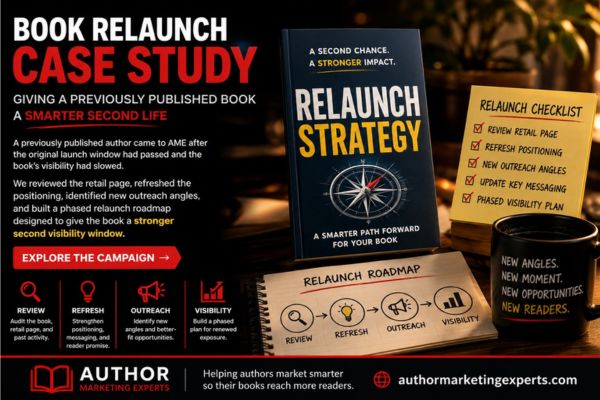
This case study shows how Author Marketing Experts helped a previously published author create a smarter book relaunch strategy after the original launch window had passed. The campaign focused on refreshed positioning, Amazon retail-page review, audience targeting, updated outreach angles, renewed visibility opportunities, and a long-term marketing roadmap designed to give the book a stronger second life without relying on book-sales claims.
Campaign Snapshot
- Book type: Fiction or nonfiction
- Genre/category: Withheld for client privacy
- Publishing stage: Previously published
- Primary challenge: The original launch did not create the visibility the author had hoped for
- Campaign focus: Book relaunch strategy, retail-page review, renewed positioning, audience targeting, visibility planning
- Client identity: Withheld at the author’s request
- Book title: Withheld at the author’s request
- Campaign type: Relaunch and renewed visibility campaign
The Book Marketing Challenge
This author came to AME after the original launch window had already passed.
And this is such a common situation.
The book had launched. There had been some initial activity. The author had done what many authors do: announced the book, posted about it, reached out to their personal network, maybe tried a few promotions, maybe pitched some contacts, maybe hoped the launch momentum would keep going.
But after that initial push, things slowed down.
The author still believed in the book. The content was still relevant. The audience was still out there. But the campaign no longer had a clear direction.
That is where many authors get stuck.
They assume that once the official launch window is over, their only options are to either keep posting about the book randomly or accept that they missed their chance.
But that is not true.
A book can absolutely have a second visibility window.
The key is that a relaunch cannot simply be a repeat of the original launch. It needs a reason, a strategy, and a stronger foundation than the first time around.
That was the opportunity in this campaign.
The author did not need to pretend the book was brand new. They needed a smarter way to reintroduce it.
What AME Found
When we reviewed the book, the author platform, and the original promotional efforts, we found that the book had not necessarily failed.
It had simply not been given a clear enough marketing structure.
The original campaign had leaned too heavily on the publication date as the main reason for visibility. That is common, but it is also limiting. “My book is out now” is not usually enough of a reason for readers, media contacts, podcast hosts, influencers, bookstores, libraries, organizations, or community partners to pay attention.
A relaunch needs stronger hooks than that.
We also found that the book’s retail page could be improved. The description needed to do more work. The category and keyword strategy needed a fresh look. The author’s messaging could be tightened. The campaign language needed to better communicate why the book mattered now, not just when it first came out.
Most importantly, the author needed to stop thinking of the book as “old.”
What new visibility opportunities can we create around this book now?
That question changed the direction of the campaign.
The Book Relaunch Strategy
Our strategy was to reposition the book for renewed visibility rather than trying to recreate the original launch.
That meant focusing on five core areas:
- Reviewing the book’s current retail and platform foundation
- Identifying what was still working and what needed to be refreshed
- Developing new campaign angles beyond the original publication date
- Building a phased relaunch plan instead of a one-day promotional push
- Creating a long-term visibility roadmap the author could continue using after the campaign
This is important because a relaunch is not just “launch again.”
A good relaunch gives the book a new reason to be discovered.
That reason might come from a seasonal angle, a current conversation, a category trend, a reader need, an updated author platform, a new audience segment, a podcast topic, a local connection, an anniversary, a series connection, an award, a new edition, a fresh Amazon page, or simply stronger positioning than the book had the first time around.
For this campaign, the goal was to move away from launch-week thinking and build something more sustainable.
Campaign Components
1. Book and Retail-Page Audit
We began with a full review of the book’s existing retail presence.
We looked at:
- Amazon book description
- Categories
- Keywords
- Author bio
- Review presentation
- Cover and genre alignment
- Comparable titles
- Reader promise
- A+ Content opportunities
- Series or backlist opportunities, where applicable
- Overall clarity of the book page
The goal was to understand whether the book page was ready for renewed visibility.
Because if the book page is not clear, compelling, and aligned with the audience, a relaunch can send people to the wrong first impression.
In this case, the book had a foundation, but it needed tightening. The page needed to better communicate the book’s value, target reader, and reason to engage.
2. Relaunch Positioning
Next, we worked on the relaunch positioning.
This is one of the most important parts of the process.
A relaunch should not be framed as:
“My book came out a while ago and I want people to notice it again.”
That may be honest, but it is not a campaign angle.
Instead, the relaunch needs to answer:
- Why this book?
- Why this audience?
- Why now?
- What conversation does this book belong in?
- What reader problem, desire, interest, or emotional hook does it speak to?
- What has changed since the book first launched?
- What new visibility path makes sense now?
For this campaign, we developed a stronger reason to reintroduce the book and tied that reason to specific audiences, outreach opportunities, and promotional windows.
3. Audience Reassessment
One of the advantages of relaunching a book is that the author often knows more than they did the first time.
They may know which readers responded. They may know which messages landed. They may know which platforms were not worth the effort. They may have reviews, reader feedback, speaking topics, podcast experience, or new professional credibility that did not exist during the original launch.
We used that information to reassess the audience.
In some cases, the audience needed to be narrowed. In other cases, there were new audience segments the author had not considered. Either way, the campaign became stronger once we stopped treating “all readers” as the goal.
A relaunch works best when it is specific.
4. Updated Outreach Angles
The campaign also needed new outreach angles.
For many authors, the first launch campaign is built around the announcement: new book, new release, now available.
A relaunch needs something else.
Depending on the book, that might include:
- A timely topic
- A seasonal hook
- A local or regional angle
- A podcast conversation
- A cultural trend
- A professional insight
- A reader-community angle
- A book-club discussion angle
- A series or backlist connection
- A holiday or awareness-month connection
- A renewed relevance angle
- A new edition or updated-resource angle
- A “what readers are still asking about” angle
For this campaign, we developed outreach language that gave media contacts, podcast hosts, influencers, community partners, and potential visibility outlets a better reason to care.
The author was no longer saying, “Please talk about my book.”
The campaign was saying, “Here is why this book belongs in this conversation.”
That is a much stronger pitch.
5. Phased Relaunch Roadmap
We also built a phased roadmap rather than treating the relaunch as a single promotional event.
That roadmap included:
- Retail-page updates
- Messaging refinement
- Audience targeting
- Outreach priorities
- Content themes
- Promotional timing
- Follow-up opportunities
- Long-term visibility actions
This matters because most books do not need one big burst and then silence.
They need a sequence.
A stronger relaunch might begin with retail optimization, then move into outreach, then content, then partnership opportunities, then seasonal visibility, then long-term follow-up. That gives the book more than one chance to be discovered.
For this author, that structure created a clearer path forward and removed the pressure of trying to make everything happen at once.
What Changed
Before the Campaign
Before the campaign, the author felt like the book’s best opportunity had already passed.
The original launch had not created the visibility they wanted, and their ongoing marketing had become inconsistent. The retail page needed improvement, the campaign angle was too tied to the original publication date, and the author did not have a clear plan for how to reintroduce the book in a meaningful way.
The book was still worth marketing, but the strategy needed a reset.
After the Campaign
After the campaign, the author had a stronger relaunch strategy and a clearer path for renewed visibility.
The book’s retail presentation was reviewed and improved. The audience targeting was more specific. The relaunch angle gave the campaign a fresh reason to exist. The outreach plan was more focused. The author had a phased roadmap that supported visibility beyond a single promotional moment.
Most importantly, the author stopped treating the book as “past its launch window.”
Instead, the book became an asset that could be reintroduced, repositioned, and supported with a smarter long-term plan.
That shift matters.
Campaign Outcomes and Progress Markers
Because we do not use case studies to make book-sales promises, the outcomes we focus on are the pieces of the campaign that improved the book’s visibility foundation, relaunch readiness, and long-term strategy.
For this campaign, those included:
- A full review of the book’s current retail and marketing foundation
- A refreshed relaunch position
- Clearer audience targeting
- Updated Amazon page recommendations
- A stronger book description and retail-page direction
- More relevant media, podcast, influencer, local, or community outreach angles
- A phased relaunch roadmap
- A better understanding of which promotional tactics were worth continuing
- A stronger plan for long-term visibility after the relaunch period
- A renewed sense of direction for a book the author still believed in
These are the pieces that make a relaunch more strategic and less reactive.
What This Book Relaunch Campaign Demonstrates
This campaign demonstrates something we wish more authors understood:
The launch date is not the only marketing opportunity your book will ever have.
Yes, the launch window matters. But if the first launch did not go the way you hoped, that does not mean the book is done.
It may mean the book needs a better foundation, a sharper audience, stronger positioning, a clearer reason to be visible now, or a campaign plan that extends beyond announcement marketing.
A relaunch can work especially well when the author is willing to look honestly at what happened the first time.
- What was missing?
- Was the Amazon page ready?
- Was the audience too broad?
- Were the pitches too generic?
- Was the campaign too short?
- Was the strategy built around the book’s real opportunity?
- Did the author stop too soon?
These are not failure questions. They are strategy questions.
And they can open the door to a much stronger second visibility window.
What Other Authors Can Learn From This
If your book has already been published and you feel like you missed your chance, you may not need to start over.
You may need to relaunch smarter.
Before you invest in more promotion, ask yourself:
- Is my Amazon page stronger now than it was at launch?
- Does my book description clearly speak to the right reader?
- Do I have better reviews, endorsements, credentials, or platform assets than I had before?
- Is there a new angle that makes this book relevant again?
- Do I know which audience I am trying to reach?
- Have I identified new outreach opportunities?
- Am I still using the same launch language even though the book is no longer new?
- Do I have a phased plan, or am I just trying random tactics?
- Am I treating this book like it is finished, or like it still has work to do in the world?
A book relaunch is not about pretending the book is new.
It is about giving the book a better strategy than it had the first time.
Is This Similar to Your Situation?
This kind of campaign may be a fit if:
- Your book launched months or years ago
- The original launch did not create the visibility you wanted
- You still believe the book has strong potential
- You have tried scattered promotional tactics without a clear plan
- Your Amazon page has not been reviewed or updated recently
- Your book description, categories, or keywords may need improvement
- You have new reviews, credentials, media experience, or platform growth since launch
- You want to reintroduce the book without sounding repetitive
- You need a smarter visibility plan for an older title
- You are preparing to release another book and want your backlist to support the new campaign
This is not about forcing attention onto a book that is not ready.
It is about looking at the book honestly, identifying what can be improved, and building a stronger path for renewed visibility.
Frequently Asked Questions About Relaunching a Book
Can you relaunch a book after it has already been published?
Yes. A book can be relaunched months or even years after publication, but the strategy needs to be different from the original launch. A relaunch should have a fresh reason for visibility, updated positioning, a reviewed retail page, and a clear audience strategy.
Is a book relaunch only for books that failed the first time?
No. A relaunch is not necessarily about failure. Sometimes a book was launched too quickly, marketed too broadly, or released before the author had a strong platform. Other times, the author has new opportunities, new reviews, a new edition, a new audience, or a better understanding of how to position the book.
What makes a book relaunch different from a book launch?
A launch is usually tied to the book’s publication date. A relaunch is tied to renewed relevance. That means the campaign needs a stronger reason than “the book is available.” It may focus on a new angle, updated positioning, seasonal timing, author platform growth, a revised Amazon page, a new edition, or a specific audience opportunity.
Should I update my Amazon page before relaunching my book?
In many cases, yes. Before sending new attention to a previously published book, it is smart to review the book description, categories, keywords, author bio, A+ Content opportunities, review presentation, and overall reader clarity. A relaunch works better when the retail page is ready to support renewed visibility.
Does AME guarantee book sales from a relaunch campaign?
No. AME does not guarantee book sales, bestseller status, reviews, media placements, or specific commercial outcomes. A relaunch campaign can improve positioning, visibility strategy, retail readiness, and outreach direction, but sales are influenced by many factors outside the control of any marketing agency.
Why are the author name and book title not included?
Some authors prefer to keep the internal details of their marketing campaigns private. To respect client confidentiality, we may withhold the author’s name, book title, and certain identifying details. The campaign strategy, challenges, and outcomes described here are based on real client work.
Check Out All of Our Book Marketing Case Studies
- Amazon Book Optimization Case Study: Retail Pages for Authors
- Pre-Publication Book Marketing Case Study: Launch Readiness
- Book Influencer Outreach Case Study: Finding Better-Fit Reviewers Instead of Chasing Bigger Accounts
- Book Marketing Strategy Case Study: Campaign Pivot & Readiness
- Book Publicity Case Study: Media Angles & Author Visibility
- Fiction Book Marketing Case Study: Amazon & Retail Optimization
- Nonfiction Book Marketing Case Study: Author Platform & Visibility
- Local Book Marketing Case Study: Turning a Book Into a Local Visibility Opportunity
Ready to Relaunch Your Book With a Smarter Strategy?
If your book has already been published but you still believe it has more work to do in the world, you may not need to give up on it.
You may need to reintroduce it with a better plan.
Author Marketing Experts helps serious authors review what is working, identify what needs to change, strengthen their retail presence, and build a renewed visibility strategy around the right audience and the right opportunities.
If you are ready to stop guessing and start building a smarter second chapter for your book, apply for a book marketing strategy consultation.
If this case study sounds familiar, these resources may also be helpful:
Book Relaunch Strategy
Book Marketing Services
Amazon Book Page Optimization
Fiction Book Marketing Services
Nonfiction Book Promotion Services
Book Publicity Services
How to Build Long-Term Book Visibility
Ready to Relaunch Your Book With a Smarter Strategy?
If your book has already been published but you still believe it has more work to do in the world, you may not need to give up on it.
You may need to reintroduce it with a better plan.
Author Marketing Experts helps serious authors review what is working, identify what needs to change, strengthen their retail presence, and build a renewed visibility strategy around the right audience and the right opportunities.
If you are ready to stop guessing and start building a smarter second chapter for your book, contact us today.
0 Comments