If you’ve spent any time researching professional book marketing, you’ve probably noticed something pretty quickly: everyone seems to offer something different.
One company promises book publicity. Another focuses exclusively on social media or advertising, while someone else offers elaborate packages that include everything from press releases to Amazon advertising.
And somehow, they’re all calling it book marketing.
Here’s the problem: Not all professional book marketing is created equal, and not everything marketed as book promotion is necessarily going to help you sell books. The key is knowing the difference.
After more than 25 years in the book marketing business, I’ve seen authors spend money on strategies that genuinely move the needle. I’ve also seen authors invest in services that sound impressive on paper but do very little to help their books reach the right readers.
The difference often comes down to understanding what you’re actually investing in, what your book needs, and what will realistically help you gain visibility with potential buyers.
So let’s unpack what professional book marketing typically involves, what it doesn’t, and what authors should understand before making a marketing investment.
What Is Professional Book Marketing?
Professional book marketing is the strategic work of positioning, promoting, and building visibility for a book with the goal of reaching appropriate readers, establishing credibility, and creating more opportunities for sales.
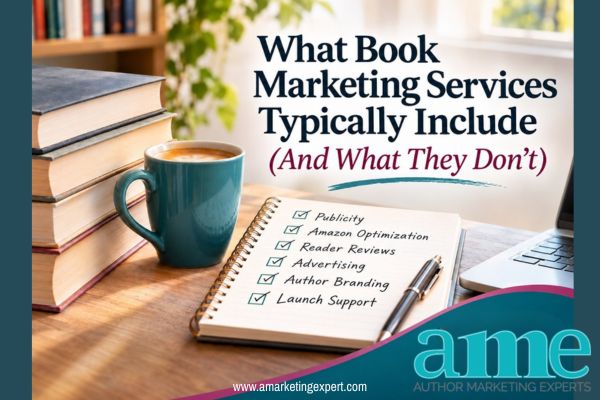
Depending on the company and the author’s goals, this work may involve Amazon optimization, book publicity, reader review outreach, influencer outreach, advertising, author branding, and targeted promotional campaigns.
But here’s an important distinction: Book marketing isn’t simply about getting attention. It’s about getting the right attention from people who are likely to buy your book.
That’s where professional experience comes in, because without strategy, you’re just throwing stuff up against the wall hoping some of it sticks.
A good book marketing company should be thinking beyond how many people might see your book. It should also be considering what happens after someone discovers it, which is where Amazon and your author branding come in.
Does your book’s description make readers want to know more? Is your Amazon page competitive? Do you have enough credibility to make a first-time reader comfortable buying? Are you targeting people who actually read your genre?
Visibility matters. But visibility without a compelling reason to buy isn’t much of a marketing strategy.
What Does Professional Book Marketing Actually Involve?
Not every company offers the same kind of support, and frankly, that’s not necessarily a bad thing. Different books need different kinds of marketing.
However, there are several core areas authors should understand when considering professional marketing support.
1. Amazon Optimization and Book Discoverability
Let’s start with one of the most important pieces of the puzzle.
For many authors, Amazon is a primary place where readers discover, research, and purchase books. And yet, I can’t tell you how many times we’ve reviewed an author’s Amazon page and found significant opportunities that were being overlooked.
Professional Amazon optimization may include:
- Keyword research based on how readers search for books.
- Category analysis and recommendations.
- Book description improvements that emphasize reader appeal.
- Amazon Author Central recommendations.
- A+ Content strategy and development.
- Competitive positioning and retail-page evaluation.
The goal isn’t simply to make your Amazon page look prettier.
It’s to help improve your book’s relevance for appropriate searches while making it more appealing to the readers who find it.
And here’s something authors sometimes miss: You can spend a considerable amount of money driving traffic to Amazon, but if your book page isn’t doing its job, you’re potentially wasting that traffic.
What authors shouldn’t expect: Guaranteed first-page rankings, permanent bestseller status, or a promise that Amazon will recommend your book to thousands of readers.
No legitimate book marketing company can guarantee those outcomes.
2. Book Publicity and Media Outreach
This is probably one of the most misunderstood areas of professional book marketing.
Authors often equate publicity with getting on television, landing a major newspaper interview, or appearing on a popular podcast.
Those opportunities can be valuable, but effective book publicity is much broader than that.
Depending on the book, professional publicity efforts may include outreach to:
- Relevant podcasts and interview programs.
- Local and regional media outlets.
- Genre-specific publications and websites.
- Niche media serving the book’s intended audience.
- Journalists and producers covering topics connected to an author’s expertise.
The key word here is relevant.
A parenting book might benefit from a targeted parenting podcast more than a brief mention in a national publication. A regional history book could find an enthusiastic audience through local media that would never be reached through a generic national campaign.
And nonfiction authors often have additional opportunities because their expertise can be connected to timely topics, industry trends, and issues journalists are already covering.
At Author Marketing Experts, we spend a lot of time considering where an author’s expertise or subject matter naturally fits, rather than simply sending out pitches and hoping something sticks.
And that’s the key. Instead of paying for a broad campaign that doesn’t get you the kind of exposure your book needs, you’re much better off being strategic and focusing on your core audience.
What authors shouldn’t expect: Guaranteed interviews, guaranteed reviews from major publications, or control over what journalists decide to cover.
Publicity is earned media. A marketing company can develop a strong pitch, identify appropriate outlets, and pursue opportunities, but the final editorial decision belongs to the media outlet.
3. Reader Reviews and Credibility Building
Reviews are another area where authors often have unrealistic expectations, sometimes because they’ve been given unrealistic promises.
Reader reviews help prospective buyers evaluate a book. They can provide valuable social proof, particularly when someone is considering an author they’ve never heard of.
Professional review outreach might include identifying appropriate reviewers, developing outreach campaigns, connecting with genre-specific review communities, and helping authors build ethical review acquisition strategies.
But there’s a distinction between helping an author pursue reviews and promising a specific number of positive reviews.
What authors shouldn’t expect: Purchased customer reviews, guaranteed five-star ratings, or control over what a reviewer writes.
Authors should be especially cautious about any company that promises positive Amazon customer reviews in exchange for payment.
Legitimate review outreach respects retailer policies, reviewer independence, and the fact that not everyone who receives a book will review it.
And frankly, that’s how it should work.
4. Book Advertising and Paid Promotion
Advertising can be an effective component of book marketing, but it isn’t automatically the right starting point for every book.
Professional advertising support may include Amazon Ads campaign development, keyword and product targeting, ad copy, budget management, performance monitoring, and ongoing adjustments.
Some companies also manage Meta advertising, promotional newsletter placements, or other paid opportunities.
The important thing to understand is that advertising amplifies what you already have. It doesn’t automatically fix a book that isn’t positioned correctly.
If your cover doesn’t appeal to your target genre, your book description isn’t compelling, or your pricing is significantly out of line with comparable titles, paid advertising may simply expose those weaknesses to more people.
We’ve seen this happen.
An author assumes they need more advertising when what they actually need is stronger positioning, better keywords, or a more compelling retail presentation.
That’s why we look at the foundation before recommending how much money an author should spend on ads.
The other element to consider is this: social media sites are literally set up to keep people on their platforms, so getting someone to click away can be challenging.
You have to have a great offer, which a lot of social media advertising does not have. Every additional step you ask someone to take creates another opportunity to lose their attention.
So when there’s a compelling offer and the author’s platform is solid, social media advertising may make sense. But this is where being strategic comes in.
What authors shouldn’t expect: Guaranteed profitability or an assurance that every advertising dollar will generate more than a dollar in sales.
Also, ask whether the advertising budget is included in the professional fee or billed separately. That distinction matters when you’re evaluating a marketing investment.
5. Author Branding and Marketing Foundations
Here’s an area of book marketing that doesn’t always sound as exciting as publicity or advertising, but it can make a significant difference.
Author branding helps readers understand who you are, what you write, and why they should pay attention.
For fiction authors, this may involve genre positioning, series branding, author bios, reader-facing messaging, and consistency across retail and online platforms.
For nonfiction authors, it may also involve establishing professional credibility, developing a clear area of expertise, and connecting the book to speaking, consulting, or other business opportunities.
Depending on the author’s needs, foundational marketing work might involve website recommendations, media kit development, messaging, social profile optimization, or email-list strategy.
The objective is consistency.
If someone hears you on a podcast, looks you up online, and then visits your Amazon page, the experience should feel connected.
What authors shouldn’t expect: Automatically building a large following, creating an established author platform overnight, or guaranteeing that branding improvements will immediately increase sales.
Brand recognition is something you build, not something you buy in a single campaign.
6. Targeted Book Promotion and Audience Outreach
This is where professional marketing approaches can vary significantly.
Some companies rely heavily on broad promotional channels. Others develop more targeted campaigns based on the book’s genre, subject matter, audience, and potential buying opportunities.
Targeted promotion may include outreach to relevant reader communities, niche influencers, book clubs, specialty organizations, professional associations, or regional audiences.
For example, a historical novel with a strong geographic setting might benefit from regional promotion alongside genre-focused outreach.
A nonfiction book addressing a specific professional challenge might have opportunities through associations, speaking engagements, or specialized newsletters.
A children’s book may have potential audiences beyond parents, including grandparents, educators, libraries, and gift buyers.
This is one of my favorite parts of book marketing because it requires thinking creatively about who might buy a book and why.
What authors shouldn’t expect: Guaranteed influencer posts, guaranteed book club selections, or automatic access to large audiences.
It also shouldn’t mean blasting the same generic pitch to thousands of people who have no particular reason to care about your book.
That’s activity. Not necessarily strategy.
7. Book Launch Planning and Campaign Management
Another important part of professional book marketing is campaign planning, particularly when an author is preparing for publication.
A book launch isn’t just one big promotional push on publication day. Ideally, it’s a series of coordinated activities that begin before the book is available and continue after release.
Depending on the campaign, launch support might include pre-publication positioning, Amazon preparation, early review outreach, appropriate publicity opportunities, promotional scheduling, and post-launch visibility strategies.
And let’s not forget books that have already been published.
One of the biggest misconceptions I encounter is that authors have missed their opportunity if their book has been out for six months, a year, or even longer.
Not necessarily!
We’ve worked with authors whose books needed a fresh marketing approach long after publication. Sometimes that means identifying new audiences, revisiting Amazon optimization, developing a new publicity angle, or connecting the book to a timely topic.
What authors shouldn’t expect: A guarantee that launch week will produce a bestseller, that every planned activity will generate coverage, or that a single campaign will sustain sales indefinitely.
Book marketing should create opportunities for momentum, but long-term success usually requires continued attention.
What Professional Book Marketing Doesn’t Guarantee
Now that we’ve covered what professional marketing can involve, let’s address something equally important: what authors shouldn’t automatically expect.
Because this is where misunderstandings can become expensive.
Guaranteed book sales: Professional marketing can improve visibility, strengthen your book’s positioning, and create more opportunities for sales. But no legitimate marketing company can guarantee how many books readers will buy.
Bestseller status: Strategic promotion, advertising, and retail optimization can help a book compete more effectively, but bestseller rankings are influenced by factors no marketing company can fully control.
Major national media coverage: A professional publicity campaign involves researching appropriate outlets, developing compelling pitches, and pursuing relevant opportunities. But journalists, producers, and editors ultimately decide what gets covered.
Hundreds of positive reviews: Ethical review outreach can introduce your book to appropriate reviewers and reader communities. It cannot guarantee how many people will leave reviews, when they’ll post them, or what they’ll say.
A large social media following: Professional marketing may support audience development and author branding, but building an engaged following takes time. A large follower count also doesn’t necessarily translate into book sales.
Bookstore placement: Depending on the campaign, marketing professionals may pursue bookstore opportunities or help improve a book’s retail readiness. But shelf placement and purchasing decisions belong to booksellers.
Unlimited marketing activities: A professional campaign should have clearly defined priorities, deliverables, and timelines. More activity isn’t automatically better marketing, and a longer list of deliverables doesn’t necessarily mean stronger results.
Publishing and distribution services: Don’t assume that hiring a book marketing company also means you’re getting editing, cover design, publishing, printing, distribution, or literary representation. Those are different functions, even when some providers offer them under the same roof.
And if you’re looking for someone to manage your social media, create video content, build your website, or run ongoing advertising campaigns, make sure those activities are specifically included in your agreement.
The bottom line? Professional book marketing should give you experienced strategic direction, realistic expectations, and a campaign built around your book’s opportunities. It shouldn’t come with promises that no one can responsibly make.
Never assume that a bigger promise means a better marketing investment.
How Much Should Authors Expect to Invest in Professional Book Marketing?
This is probably the next question authors ask, and understandably so.
The cost of professional book marketing varies considerably based on the scope of the campaign, the amount of research and customization involved, the length of the engagement, and how much work the marketing team is actually doing.
A limited promotional service may cost a few hundred dollars. Focused optimization or consulting services can cost more, while comprehensive campaigns involving publicity, advertising, outreach, and campaign management can run into several thousand dollars or considerably more.
But here’s what I want authors to understand:
The cheapest marketing option isn’t necessarily the best value. And the most expensive one isn’t necessarily the most effective.
I’ve seen authors become fixated on how many deliverables they’re receiving.
Fifty pitches! Twenty social posts! Ten promotional placements!
Sounds impressive, right?
But what if those fifty pitches are going to the wrong media outlets? What if the social posts aren’t reaching potential buyers? What if the promotional placements generate traffic but very few sales?
Suddenly, those impressive numbers don’t look quite so impressive.
I’d much rather see an author invest in a smaller, well-researched campaign that addresses the book’s actual marketing challenges.
For a more detailed breakdown, read our guide to what book marketing actually costs and how to budget for it.
Why the Right Marketing Strategy Depends on Your Book
Here’s where I think authors can make much smarter decisions.
Instead of starting with a list of services, start by understanding the problem you’re trying to solve.
If your book isn’t getting discovered: There may be opportunities involving Amazon keywords, categories, genre positioning, or more targeted outreach.
If people are discovering your book but aren’t buying: Your cover, description, pricing, reviews, or overall retail presentation may need attention before you invest in additional visibility.
If you’re a nonfiction author trying to build credibility: Relevant podcast interviews, media outreach, speaking opportunities, or a stronger author platform may offer more value than a broad social media campaign.
If you’re launching a new fiction series: Your marketing priorities may involve retail optimization, genre-specific reader outreach, early review strategies, and building a readership that will return for future books.
If your book has been out for a while and sales have stalled: There may be opportunities to revisit its market positioning, competitive titles, target readership, or promotional approach.
Notice something?
These are different problems. And they require different solutions.
But that doesn’t mean you should have to figure out exactly which marketing services you need before approaching a professional.
In fact, that’s part of what you’re hiring an experienced marketing team to evaluate.
That’s why I’m always cautious about marketing companies that recommend the exact same package to every author.
Your book isn’t identical to every other book on the market. Your marketing strategy shouldn’t be either.
What Should Authors Understand Before Hiring Professional Marketing Help?
Before investing in professional book marketing, I encourage authors to have realistic expectations about how the process should work.
A good marketing company should be able to explain how it evaluates your book’s marketplace, identifies appropriate opportunities, and develops recommendations based on your goals.
You should also understand what the campaign includes, who’s doing the work, what additional expenses may apply, and how progress will be communicated.
And here’s one thing I think is particularly revealing:
Is the company willing to tell you what you shouldn’t spend money on?
I love this consideration.
Because an experienced book marketing professional should be willing to tell you when a particular strategy isn’t appropriate for your book.
Sometimes the best recommendation isn’t adding another service.
It’s eliminating one.
That kind of judgment comes from understanding the marketplace, not simply having a long list of promotional activities available.
For additional guidance, read our article on what actually makes a good book marketing company.
How AI Is Changing Professional Book Marketing
We also need to talk about how book discovery is evolving.
Readers aren’t just finding books through bookstores, Amazon searches, or traditional media anymore.
They’re also using AI-powered search tools to research topics, discover authors, compare books, and ask for reading recommendations.
That means an author’s digital presence is becoming increasingly important.
Think about a reader asking an AI tool for historical mysteries set in a particular region, or a business owner searching for books about leadership challenges.
Will your book be represented accurately in the information those systems can access? Is its subject matter clear? Does your author website reinforce your expertise or genre? Are there credible third-party sources that discuss your work?
These are questions worth asking.
This doesn’t mean every author needs an expensive new service labeled “AI book marketing.”
In fact, I’d be very cautious about anyone promising guaranteed placement in ChatGPT recommendations or other AI-generated answers.
But it does mean that professional book marketing should increasingly consider how authors and books are represented across search engines, retail platforms, and AI discovery environments.
Clear positioning, consistent information, credible media coverage, useful author websites, and relevant third-party mentions can all contribute to a stronger discoverability foundation.
There’s no guarantee an AI system will recommend a particular book. But authors can make it easier for readers and discovery systems to understand what their books offer.
And that’s an important distinction.
Why Effective Book Marketing Requires More Than Individual Tactics
Here’s something I’ve learned after working with authors for more than two decades.
The most effective marketing campaigns rarely depend on one spectacular activity.
Instead, they connect several carefully chosen strategies.
A reader might discover your book through a podcast interview, look you up online, visit your Amazon page, read a few reviews, and finally decide to purchase.
Which activity made the sale?
That’s not always easy to determine.
But every step helped create the opportunity.
This is why I believe book marketing should be treated as an ecosystem rather than a checklist.
Your publicity should support your discoverability. Your Amazon page should support your advertising. Your author brand should reinforce the message readers encounter elsewhere.
And the entire campaign should be built around reaching people who are genuinely interested in the kind of book you’ve written.
Not just generating more noise.
Frequently Asked Questions About Professional Book Marketing
Is professional book marketing worth paying for?
It can be, particularly when an author needs specialized expertise, strategic guidance, or professional outreach support. Its value depends on whether the work addresses the book’s actual needs, is executed effectively, and fits the author’s budget. No marketing investment guarantees a particular sales outcome.
Do professional book marketers guarantee book sales?
Reputable book marketing professionals generally do not guarantee sales. They can improve positioning, develop promotional opportunities, manage advertising, and support discoverability, but buying decisions are ultimately made by readers.
What’s the difference between book marketing and book publicity?
Book marketing encompasses the broader strategy of positioning, promoting, and selling a book. Book publicity focuses primarily on earning media attention, such as interviews, features, and editorial coverage. Publicity can be one component of a larger marketing campaign.
Can I hire professional book marketing help after my book is published?
Absolutely. Many authors benefit from marketing support months or years after publication. Depending on the book, a post-publication campaign may focus on Amazon optimization, new audience opportunities, refreshed publicity angles, advertising, or renewed reader outreach.
Does professional book marketing include Amazon advertising?
It may, depending on the company and the campaign. Amazon Ads can be part of a broader strategy, but advertising isn’t automatically appropriate for every book. Authors should also understand whether advertising spend is included in the quoted price or billed separately.
How long does professional book marketing take to work?
Some promotional activities can generate attention quickly, while other strategies take weeks or months to develop. Publicity outreach, retail optimization, reader engagement, and audience building all operate on different timelines. Results also depend on the book’s market readiness and competition.
Do I need to know which marketing services my book needs before contacting a professional?
No. An experienced book marketing company should be able to evaluate your book, your goals, your intended readership, and the competitive marketplace before recommending an appropriate strategy.
You don’t need to become a book marketing expert before hiring one.
Final Thoughts: Invest in the Right Strategy, Not Just More Marketing
If there’s one thing I hope you take away from this article, it’s that professional book marketing shouldn’t be about buying the longest list of promotional activities.
It should be about finding a team that understands your book, your readers, your goals, and the realities of today’s publishing market.
Sometimes that means publicity. Sometimes it means Amazon optimization. Sometimes it means advertising, reader outreach, or building a stronger author foundation.
And sometimes it means taking a closer look at why your existing marketing isn’t producing the results you expected.
At Author Marketing Experts, we’ve spent more than 25 years helping authors navigate these decisions. One thing that experience has taught us is that successful book marketing isn’t about doing everything.
It’s about doing the right things, in the right order, for the right audience.
And that can make all the difference.
Considering Professional Book Marketing for Your Book?
You may know your book needs more visibility, but that doesn’t mean you should be expected to know which strategies will make the most sense.
That’s where professional experience matters.
At Author Marketing Experts, we start by understanding your book, your goals, your audience, and where the strongest opportunities may be. We don’t believe every author needs the same marketing approach, and we don’t expect you to figure out your own campaign before reaching out.
Because successful marketing isn’t about doing more. It’s about making smarter decisions based on your book’s actual opportunities.
Learn more about our approach to book marketing or contact our team to start a conversation about your book.
We’d love to learn more about what you’re working on.
0 Comments