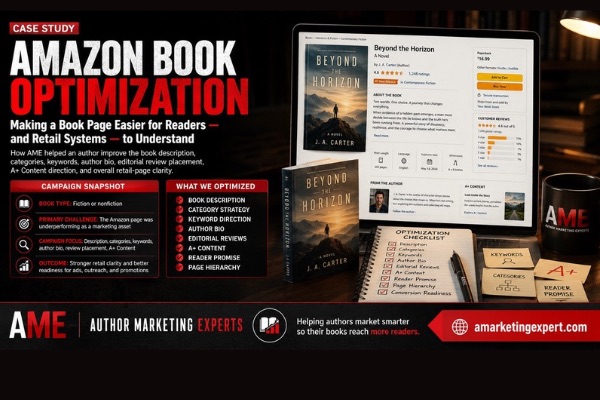
Answer Block: This case study shows how Author Marketing Experts helped an author strengthen their Amazon book page before investing in broader promotion. The campaign focused on book description optimization, Amazon categories, keyword strategy, author bio improvements, review presentation, A+ Content opportunities, and stronger alignment between the book’s reader promise and its retail-page presentation.
Campaign Snapshot
| Book type | Fiction or nonfiction |
| Genre/category | Withheld for client privacy |
| Publishing stage | Published or preparing for renewed visibility |
| Primary challenge | The book page was not clearly communicating the book’s value to readers or supporting discoverability |
| Campaign focus | Amazon optimization, book description, categories, keywords, author bio, retail-page clarity |
| Client identity | Withheld at the author’s request |
| Book title | Withheld at the author’s request |
| Campaign type | Amazon retail-page optimization and discoverability review |
The Book Marketing Challenge
This author came to AME wanting to improve visibility for their book.
That is where a lot of authors begin. They want more readers, more attention, more discoverability, more traction. They may be thinking about ads, publicity, promotions, social media, podcast outreach, influencer outreach, or a launch or relaunch campaign.
But before we recommend sending more people to a book page, we need to look at the page itself.
Because Amazon is not just a place where books are sold.
It is also one of the most important marketing pages an author has.
For many readers, Amazon is where the decision happens. They may hear about the book somewhere else, but they often end up on the Amazon page before deciding whether to buy, sample, follow the author, read reviews, or move on.
That means the page has a job to do.
It has to communicate quickly. It has to match the reader’s expectations. It has to support the book’s category. It has to make the promise of the book clear. And it has to help Amazon understand where the book belongs.
In this campaign, the book had potential, but the Amazon page was not working hard enough.
The author did not need to start with more promotion.
They needed to improve the place where promotion would send readers.
What AME Found
When we reviewed the Amazon page, we found several issues that are very common.
The book description was doing some of the right things, but not enough of them. It described the book, but it did not lead strongly enough with the reader promise. It had useful information, but the structure made it harder for readers to quickly understand why the book was relevant to them.
The categories and keywords also needed review. Some were too broad. Some were not aligned closely enough with the book’s actual audience. Some may have been technically accurate but not strategically useful.
That happens all the time.
Authors often choose categories and keywords based on what sounds close enough, what seems popular, or what they think the book is “about.” But Amazon optimization is not just about describing the book. It is about helping the book sit in the right discoverability lane.
We also found opportunities to strengthen the author bio, review presentation, and overall page flow.
The book page had the raw materials. It just needed a more intentional retail strategy.
The Strategy
Our strategy was to make the Amazon page easier for both readers and retail systems to understand.
- Clarifying the book’s reader promise
- Strengthening the book description
- Reviewing categories and keywords for better discoverability
- Improving author bio and credibility signals
- Identifying retail-page opportunities that could support future promotion
The goal was not to “stuff” the page with keywords or make the book sound like something it was not.
The goal was alignment.
The description, categories, keywords, author bio, reviews, and visual assets should all reinforce the same message:
This is what the book is.
This is who it is for.
This is why the right reader should care.
When those signals are aligned, the book page becomes a stronger foundation for every other part of the campaign.
Campaign Components
1. Reader-Promise and Positioning Review
We started by clarifying the book’s reader promise.
For fiction, that might mean the emotional experience, genre fit, tropes, tone, pacing, setting, suspense level, romantic payoff, mystery structure, or comparable reader expectations.
For nonfiction, that might mean the reader problem, practical takeaway, transformation, expertise, credibility, framework, audience need, or professional relevance.
In both cases, the core question is the same:
What is the reader supposed to understand quickly?
A book page should not make readers work too hard to figure out whether the book is for them.
In this campaign, the book’s promise needed to be brought forward more clearly so the rest of the page could support it.
2. Book Description Optimization
The book description was one of the most important parts of the review.
A lot of book descriptions are either too flat, too long, too vague, too plot-heavy, too credential-heavy, or too focused on what the author wants to say instead of what the reader needs to understand.
For this campaign, we reviewed the description for:
- Opening hook
- Reader clarity
- Genre or category fit
- Emotional or practical promise
- Structure and flow
- Scannability
- Keyword opportunities
- Call-to-action strength
- Tone and pacing
- Credibility and relevance
- Overall conversion support
The revised direction made the book description more reader-facing and easier to scan.
That matters because readers do not study book pages.
They skim, decide, compare, sample, and move on quickly.
A stronger description gives the right reader more reasons to stay.
3. Category Strategy
Next, we reviewed the Amazon category strategy.
This is one of the areas where authors can easily get tripped up.
A category can be technically correct but still not be the best strategic fit. A book can be placed too broadly, too competitively, too vaguely, or in a category that does not reflect how readers actually discover similar books.
The goal is not just to pick a category that describes the book.
The goal is to help the book sit where it has the best chance of being understood by readers and by Amazon’s retail ecosystem.
For this campaign, we looked at genre, subgenre, topic, comparable books, reader behavior, competition, and category relevance.
The result was a stronger category direction that better supported the book’s discoverability.
4. Keyword Review
We also reviewed the keyword strategy.
Amazon keywords should not be random. They should not be chosen only because they have high search volume. And they should not be so broad that the book disappears into a sea of unrelated results.
Good keywords are connected to how readers search, how the book is positioned, what the book promises, and where the book belongs in the market.
For fiction, that may involve genre, tropes, setting, mood, character dynamics, and comparable reading experiences.
For nonfiction, it may involve reader problems, topic language, professional categories, outcomes, frameworks, and practical needs.
For this author, we identified keyword opportunities that better matched the book’s audience and positioning.
The goal was to improve relevance, not chase every possible search term.
5. Author Bio and Credibility Signals
The author bio is often overlooked, but it matters.
For nonfiction authors, the bio helps establish authority, credibility, lived experience, professional expertise, or topic relevance.
For fiction authors, the bio can reinforce genre, personality, series identity, reader connection, or author brand.
In this campaign, the author bio was present, but it was not doing enough strategic work.
We recommended adjustments so the bio better supported the book, the author’s credibility, and the larger campaign.
We also looked at other trust and presentation signals, including editorial reviews, reader reviews, A+ Content opportunities, and the overall consistency of the page.
A strong Amazon page is not built from one element.
It is built from the way all the elements work together.
What Changed
Before the Campaign
Before the campaign, the book’s Amazon page existed, but it was not fully optimized as a marketing asset.
The description was not as reader-focused as it needed to be. The category and keyword strategy needed more precision. The author bio could have done more credibility work. The page was not communicating the book’s value quickly enough or consistently enough.
The book had visibility potential, but the page was not ready to support a stronger campaign.
After the Campaign
After the campaign, the author had a clearer and stronger Amazon optimization strategy.
The book description direction was more compelling and reader-facing. The category and keyword recommendations were more intentional. The author bio was better aligned with the book and campaign. The page had clearer retail signals and stronger support for future promotion.
Most importantly, the author had a better understanding of why Amazon optimization should not be treated as a quick technical task.
It is a strategic marketing foundation.
Campaign Outcomes and Progress Markers
Because we do not use case studies to make book-sales promises, the outcomes we focus on are the pieces of the campaign that improved the book’s retail readiness, discoverability foundation, and marketing alignment.
For this campaign, those included:
- A clearer reader promise for the book
- A stronger book description strategy
- More focused Amazon category recommendations
- More relevant keyword direction
- Improved author bio recommendations
- Better alignment between book positioning and retail-page copy
- Review of A+ Content opportunities
- Clearer comparable-title or comparable-author direction
- A stronger foundation for ads, outreach, promotions, and long-term visibility
- A more strategic understanding of how the Amazon page supports the larger campaign
These outcomes matter because almost every visibility effort eventually asks the reader to make a decision.
The Amazon page needs to help that decision, not complicate it.
What This Campaign Demonstrates
This campaign demonstrates one of the most important points we make to authors all the time:
Do not send more visibility to a weak book page.
That does not mean the page has to be perfect. But it does need to be clear, aligned, and reader-focused.
If an author runs ads before the description is strong, the ads have to work harder.
If an author gets publicity before the Amazon page is ready, the attention may not translate into meaningful reader interest.
If an author pitches influencers before the positioning is clear, the outreach may feel vague.
If an author launches before categories and keywords are reviewed, the book may be harder to discover.
Amazon optimization is not the only piece of a campaign, but it is often one of the first pieces that should be reviewed.
Because the retail page is where interest becomes a decision.
What Other Authors Can Learn From This
If your book is published or preparing to launch, your Amazon page deserves serious attention.
Before you invest in more promotion, ask yourself:
- Does my book description speak to the right reader?
- Is the opening strong enough to keep someone reading?
- Are my categories helping readers understand where the book belongs?
- Are my keywords aligned with real reader search behavior?
- Does my author bio support credibility or reader connection?
- Are my reviews and editorial quotes being used effectively?
- Would A+ Content make the page stronger?
- Does my Amazon page match the way I talk about the book elsewhere?
- Am I sending traffic to a page that is ready for it?
These are not minor details.
They are part of the book’s marketing infrastructure.
Is This Similar to Your Situation?
This kind of campaign may be a fit if:
- Your book is published but your Amazon page has not been professionally reviewed
- You are preparing to launch and want your retail page ready before promotion begins
- Your book description feels flat, vague, too long, or too plot-heavy
- You are unsure whether your categories and keywords are helping
- You want to run Amazon ads but are not sure the page is ready
- You have reviews or editorial praise but are not using them strategically
- Your author bio does not fully support your credibility or brand
- You are planning publicity, outreach, or influencer marketing and want the book page cleaned up first
- You suspect your book is marketable, but the retail presentation is not strong enough
- You want a smarter foundation before investing in broader visibility
This is not about tweaking a few words and hoping for magic.
It is about making the book easier to understand, easier to position, and easier for the right reader to evaluate.
The AME Campaign Lesson
More visibility does not help if the book page is not ready to receive it.
Amazon optimization gives the rest of the campaign a stronger place to land.
Frequently Asked Questions
What is Amazon book optimization?
Amazon book optimization is the process of improving a book’s retail-page presentation and discoverability signals. This may include the book description, categories, keywords, author bio, editorial reviews, A+ Content, comparable positioning, and overall reader clarity.
Why does the Amazon book page matter so much?
The Amazon page is often where readers make the decision to buy, sample, follow, or move on. Even if readers discover the book through publicity, ads, podcasts, social media, email, or events, many still visit the Amazon page before taking action. A stronger page gives the rest of the campaign better support.
Should authors optimize Amazon before running ads?
In many cases, yes. Ads send traffic to the book page. If the page is unclear, poorly positioned, or not reader-focused, the ads may struggle. Reviewing the description, categories, keywords, author bio, reviews, and A+ Content opportunities before investing in ads can help create a stronger foundation.
Are Amazon categories and keywords really important?
Yes, but they should be chosen strategically. Categories and keywords help support discoverability and reader understanding. They should reflect the book’s genre, topic, audience, reader expectations, and market position rather than being selected randomly or based only on popularity.
Does AME guarantee sales from Amazon optimization?
No. AME does not guarantee book sales, bestseller status, reviews, ad performance, rankings, or specific commercial outcomes. Amazon optimization can improve retail-page clarity, discoverability strategy, and campaign readiness, but sales are influenced by many factors outside the control of any marketing agency.
Why are the author name and book title not included?
Some authors prefer to keep the internal details of their marketing campaigns private. To respect client confidentiality, we may withhold the author’s name, book title, and certain identifying details. The campaign strategy, challenges, and outcomes described here are based on real client work.
Check Out All of Our Book Marketing Case Studies
- Pre-Publication Book Marketing Case Study: Launch Readiness
- Book Influencer Outreach Case Study: Finding Better-Fit Reviewers Instead of Chasing Bigger Accounts
- Book Marketing Strategy Case Study: Campaign Pivot & Readiness
- Book Publicity Case Study: Media Angles & Author Visibility
- Book Relaunch Case Study: Renewed Visibility Strategy for Authors
- Fiction Book Marketing Case Study: Amazon & Retail Optimization
- Nonfiction Book Marketing Case Study: Author Platform & Visibility
- Local Book Marketing Case Study: Turning a Book Into a Local Visibility Opportunity
Ready to Strengthen Your Amazon Book Page?
If your Amazon page is not clearly communicating your book’s value, your marketing may be working harder than it should.
Author Marketing Experts helps serious authors improve book descriptions, category strategy, keyword direction, author bios, retail-page clarity, and the Amazon foundation that supports broader visibility.
If you are ready to make your book page stronger before sending more attention to it, apply for a book marketing strategy consultation.
0 Comments