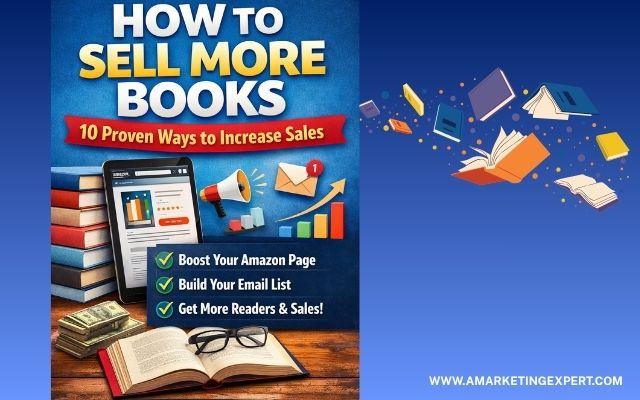
If you want to sell more books, the answer usually isn’t to do more marketing. It’s to do smarter, more strategic marketing.
One of the biggest mistakes I see authors make is throwing themselves at every possible tactic at once. And let’s face it, there’s always something new to try, right? But does it all work for your particiular situation? That’s debatable.
I often see authors post haphazardly on social media, dabble in ads, chase reviews, try giveaways, pitch media, and still feel frustrated when sales don’t move. The problem usually isn’t effort. The problem is that the sales foundation isn’t strong enough yet.
If your cover isn’t right for the market, your book description isn’t converting, your Amazon page feels unfinished, or your messaging is too vague, more promotion won’t fix it. It will just send more people to a page that doesn’t persuade them to buy.
So if you’re wondering how to sell more books, start here. These are the strategies that matter most now, the same kinds of practical book marketing moves Amy and I talk about all the time on the podcast. Not fluff. Not theory. Just the things that actually help authors increase visibility, improve conversions, and build momentum over time.
1. Make Sure Your Book Is Positioned for the Right Reader
A lot of book sales problems are really positioning problems. Meaning: your genre is unclear or altogether wrong.
If readers can’t tell who the book is for, what kind of reading experience they’ll get, or why they should care, they won’t buy. It doesn’t matter how hard you promote a book if the packaging and messaging are attracting the wrong audience or confusing the right one.
One of the biggest red flags that tell me the author is in this position is when they tell me: “It doesn’t have a particular genre.” or “This book is multiple genres.”
So let’s dig deeper. Start by asking yourself:
- Does the cover clearly signal the genre or category?
- Does the title and subtitle make sense for the market?
- Does the description promise the right emotional payoff or reader benefit?
- Would someone in your target market immediately recognize this as a book for them?
This is where selling more books really starts. Before you spend more time trying to get attention, make sure your book is positioned in a way that gives that attention a chance to convert.
2. Fix Your Cover If It Isn’t Competitive
Authors hate hearing this, but covers sell books.
Your book cover is not decoration, it’s not an art project. It is a sales tool. It has one job: get the right reader to stop scrolling and pay attention. If it looks amateur, confusing, off-market, or dated, readers will move on without giving your book a second thought.
This is especially true on Amazon, where your cover is often being viewed as a tiny thumbnail surrounded by competing titles. It has to communicate the reader promise fast.
A strong cover should:
- Fit your genre or category
- Clearly convey the benefits or promise to the reader
- Look professional at full size and thumbnail size
- Use readable typography
- Create immediate clarity, not confusion
You do not need a cover that is wildly unique just for the sake of being different. You need a cover that looks like it belongs in the market while still standing out in the right way.
3. Rewrite Your Book Description to Convert Browsers Into Buyers
Your book description is one of the most overlooked sales tools authors have and yet a lot of authors spend very little time crafting a great description.
Many descriptions are too long, or too vague, and as often the case, they’re packed with backstory, or completely obscure, giving the reader nothing tangle to anchor their interest to. Even worse, some descriptions are too focused on explaining the book instead of selling it. Readers do not study book descriptions. They scan them. Much like anything online, we don’t read we scan. Which is why your description needs to get to the point quickly.
For fiction, lead with the hook, then focus on the stakes, and the emotional pull. Give readers enough to want more, but don’t explain the whole plot.
For nonfiction, clarity wins. Show the problem – focus on the paint point you’re addressing. Then the outcome, and the reason your book is worth their time. Whenever possible, I recommend using bullets to make benefits easy to scan.
A strong description should include:
- A clear hook at the top: always lead with a hook or elevator pitch (we did a podcast on elevator pitches, so be sure to check that out!)
- Reader-focused language: save the $5 words and use language that the reader can relate to.
- Simple formatting and white space: when you have a lot of text jammed into one cluttered paragraph it’s hard for the eye to scan
- A reason this book is different or especially useful: what’s your unique selling point?
- A tone that matches the market: again, speak to your reader not at them – there’s a difference!
If your description reads like a summary instead of a sales page, rewrite it.
4. Improve Your Amazon Page Before You Drive More Traffic
I say this all the time because it matters that much: don’t send traffic to a weak retail page. How do you know if your retail page is weak? Well, the first sign is a lack of sales. But to dig even deeper into this, let’s say you’re running ads – whether on Amazon or social media and let’s say that your ads are sending lots of traffic to your retail page, but no one seems to be buying. That’s a red flag that something on your retail page is not working.
A solid retail page is more than just having a cover and a description uploaded. It means making the page feel complete, credible, persuasive – and competitive.
For starters, review your book page with a critical eye:
- Is the description polished and easy to read?
- Is there enough white space and have the paragraphs been kept short?
- Do you have quality reviews coming in? Even just a few at a time, consistent reviews matter.
- Is your Author Central page updated?
- Did you upload an author photo? Don’t be a grey box on Amazon!
- Are your categories and keywords aligned with the book?
- If you have a series, is it clearly connected?
- If you have access to A+ Content or editorial review space, are you using it well?
Authors spend a lot of time trying to get people to Amazon and not nearly enough time making sure the page is ready when they get there. That is a costly mistake.
5. Stop Trying to Market Everywhere
You do not need to be everywhere to sell more books, just everywhere that matters.
It’s often tempting to be everywhere and I get it. You feel like you need to do everything possible to market your book. But forcing yourself to be everywhere is one of the fastest ways to burn out and get mediocre results across the board. The better approach is to choose the platforms and marketing channels that appeal to your reader, in otherwords follow your reader and then show up there consistently.
Some things you may consider:
- Email marketing
- Podcasts
- Local media
- Amazon ads
- BookBub ads
The above isn’t a complete list, of course and if you’ve spent anytime marketing your books you already know this list could be five times longer. But the point is that I’d rather see an author who does really well on one or two items, than show up (or post) half-heartedly across six. Focus creates momentum. Scattered effort creates exhaustion.
6. Build an Email List You Actually Use
With all of the cool new things to try in book marketing, an email list probably seems pretty outdated. But it’s not. In fact authors who have active email lists do better, regardless of genre, than authors who do not. So if you want to sell more books over the long term and if you want your readers to help you sell books: build your email list.
Social media is useful, but it is borrowed space. Your email list is yours. It gives you a direct way to reach readers when you have a new release, a promotion, bonus content, an event, or something worth sharing.
And no, you do not need a giant list to make it worthwhile. A smaller, engaged list is incredibly valuable. In fact I’ve worked with authors who have just fifty people on their newsletter list and they do great. But the subscribers are active, engaged, and eager to help.
To grow your list, offer readers a reason to sign up – this is also called a reader magnet. This might be:
- A sample chapter
- A bonus scene
- A workbook or checklist
- A reader guide (discussion guide)
- A quiz
- A useful free resource tied to your topic
Then use your list. Don’t collect subscribers and go quiet for months. Stay in touch – even if it’s just monthly. Share updates. Be helpful. Give readers a reason to remember you and to help you out!
7. Focus on Reviews the Right Way
Reviews still matter because they help build trust – they’re social proof and they also reassure a hesitant buyer that your book is worth the money and worth the time. And I get it, review building can be hard. Also, sometimes authors often go about review-building in the wrong way, either by waiting too long, making the ask too vague, or relying entirely on strangers to somehow find the book and review it. Here’s a fact: less than 2% of consumers who buy a book on Amazon review it. So you really have to help this along. That’s also where your newsletter comes in.
Which is why starting with the readers closest to your orbit is a solid idea, from there you can work outward.
That may include:
- Advanced readers (also called ARC readers)
- Launch team members
- Loyal readers i.e. newsletter subscribers
- Professional peers or topic-adjacent contacts for nonfiction
You should also make it easy for readers to leave a review by reminding them in your back matter with a reader letter. Amy and I have talked about the important of this on our podcast, too!
Reviews are rarely built by accident. The authors who get them consistently usually have a system for asking.
8. Use Ads to Amplify What’s Working, Not Rescue What Isn’t
Ads can absolutely help sell more books, but only if the fundamentals are already in place.
If your cover is weak, your description is underperforming, your categories are off, your ads are targeting the wrong market, or the book has no real sales path behind it, ads will just expose those problems faster.
My goal is to always recommend ads when they are supporting a book that is already well-positioned.
A few examples might be:
- Amazon ads driving visibility for a polished retail page
- BookBub ads supporting a price promotion
- Social media ads supporting a limited time deal or price discount
- Campaigns built around a strong first-in-series title
Keep in mind that you can run ads without a price promotion or discount. Often I’ll run Amazon ads during the pre-order phase of the book then continuing through the book launch.
Don’t approach ads like a magic button. Approach them like fuel. If the engine is strong, they can help you go farther. If the engine is broken, fuel won’t fix it.
9. Give Readers a Clear Next Step
One of the smartest ways to sell more books is to stop thinking only about the first sale. So what happens after someone finishes your book?
If the answer is “I’m not sure,” then you’re leaving money and momentum on the table. And while you may think that the next step is obvious, it probably isn’t. Consumers almost always need a next step. Hence why you sign up to “get notifications” you often get many. Because retailers know that people rarely make buying choices immediately – and we forget. Not intentionally, but we’re busy. We’re doing a lot of things. So make it a habit to make sure that readers have a next step. And for everyone reading this that next step will be different. Here are a few ideas:
- The next book in the series
- Another title in your backlist
- Your email list (this should always be part of your next step)
- A bonus resource (for signing up for your newsletter)
- An audiobook edition
- A workbook or companion guide
This is one of the reasons back matter matters so much. The back of your book should not be dead space. It should guide readers toward staying connected and buying again.
The easiest sale you will ever make is often to someone who already liked your work.
10. Treat Book Marketing Like a System, Not a One-Time Push
Authors get into trouble when they treat marketing like a short burst of activity around launch and then disappear. The key to successful book marketing is targeting the right readers and the right marketing, but none of this matters if you’re not consistent.
That means having a repeatable system for:
- Updating your retail pages
- Growing your email list
- Getting reviews
- Showing up on one or two key platforms
- Running occasional promotions
- Pitching podcasts, media, or local opportunities when relevant
- Creating a path from one book to the next
Ideally you should be doing 2-3 things consistently to promote your book(s). The truth is that authors who sell more books over time are rarely the ones doing the most. They are the ones doing the right things consistently enough for momentum to build.
Why Most Authors Struggle to Sell More Books
If your sales are flat, it does not automatically mean the book is bad. More often, it means one of these issues is getting in the way:
- The book is positioned for the wrong audience
- The cover is not competitive
- The description is not converting
- The Amazon page is incomplete or weak
- There is no real email strategy
- Marketing efforts are too scattered
- Readers have no next step after finishing the book
That is actually good news, because most of these are fixable.
You do not need 125 random tactics. You need the right few strategies, done well.
Final Thoughts on How to Sell More Books
If you want to sell more books, start by tightening the basics. Fix the packaging. Strengthen the retail page. Get clear on your audience. Build your email list. Create a better reader path. Then choose the marketing channels that genuinely fit your book, your reader, and your bandwidth.
Book marketing works best when it is clear, intentional, and sustainable.
That is how you build visibility. That is how you improve conversions. And that is how you increase sales without wasting time on tactics that never should have been your focus in the first place.
If you want help with the pieces that matter most, especially Amazon optimization, positioning, or building a smarter launch and visibility strategy, that’s exactly the kind of work we do every day.
Resources & Free Downloads
How to create an elevator pitch that draws in more reader interest.
Check out our tips for avoiding author burnout.
The game-changing update that links Goodreads and Amazon.
Let’s talk all things media coverage and how to get it.
Marketing versus sales and why you have to understand the difference.
Let’s talk Amazon metadata and how it serves your sales goals.
How to set realistic dreams for your book and make them happen.
How to become a thought leader the media’s interested in.
Don’t make this common Amazon ads mistake.
Why you need to prep for holiday sales in the summer.
Is your Amazon author bio costing you sales?
How Amazon reviews are changing for readers, and how you can help.
Check out all the episodes of our book promotion podcast anywhere you listen to podcasts!
Follow us on Instagram for book marketing tips and some much-needed levity
Thank you for this information! “125 Book Promotion”
I’d love to read and share an updated version of this list!
most helpful— reminded me what i need to do! thank you
Thank you.