If you’ve been searching for how to sell more books, you’re probably getting the same recycled advice: post more on social, discount more often, run ads, hope for the best.
Here’s the truth: selling more books consistently isn’t about doing more random marketing. It’s about building a system that works even when Amazon changes the rules (because it does), and even when your social reach dips (because it will). Or, as is the case as I’m writing this blog post – Amazon is having a massive nationwide outage, which I realize isn’t a common occurrence, but I’m seeing savvy authors on social media push readers to alternative sources, which is what we’re doing to dig into today!
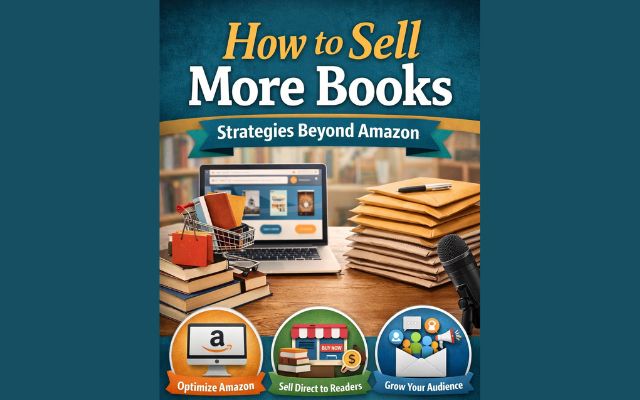
In my work with authors, I see the same pattern again and again: the authors who sell steadily are the ones who stop relying on a single channel and build three sales “lanes” that support each other:
- Lane 1: Amazon optimization (because buyers are already there)
- Lane 2: Direct-to-consumer sales (because higher margin + customer data)
- Lane 3: Audience ownership (because repeat buyers come from relationships, not algorithms)
In this post, I’ll walk you through a simple, step-by-step way to increase book sales without being dependent on one just one platform. Yes, Amazon matters. No, you don’t want it to be your only plan.
Why “How to Sell More Books” Usually Fails as a Strategy
Most authors don’t have a book problem. They have a systems problem.
They’re doing activities (posting, boosting, discounting) without a clear path that connects:
- Visibility (people find you)
- Conversion (people buy)
- Retention (people buy again)
When those three pieces work together, you sell more books. When they don’t, you get “busy” marketing that creates noise but not sales. Noise doesn’t sell books, but sadly it’s generally the marketing bucket that authors dip into.
The 3-Channel Strategy to Sell More Books (Without Over-Relying on Amazon)
Let’s break this down into the three lanes that create stable, scalable book sales.
Lane 1: Amazon Optimization (Because It’s Still the Biggest Bookstore Online)
Even if you want to sell more books without being dependent on Amazon, you still need your Amazon presence to convert. Why? Because Amazon is where readers search, compare, and often “check” you before they buy somewhere else.
Here are the non-negotiables that directly impact conversion on Amazon:
- A genre-aligned cover that meets reader expectations and signals the right promise – fast
- Categories that match buyer expectations not just what you “like” but what actually fits with your genre
- Keywords that reflect how readers search more often than not this is not how authors describe their books, which is why some deep dive research into this matters
- A book description that sells again this has to match reader expectations, it should have a hook, clarity, and an obvious “fit”
- Reviews and social proof that reduce buyer hesitation
Important: You can drive all the traffic you want, but if your retail page isn’t converting, you won’t see meaningful sales lifts. And I’ve done a ton of podcast episodes with my co-host Amy, so if you’re confused about this check out our podcast!
Quick Retail Page Reality Check
Ask yourself:
- Can a reader tell what the book is in 3 seconds?
- Does the description make the reader feel like the book was written for them?
- Do you have enough reviews to make a new buyer feel safe purchasing?
Keep in mind that Amazon ads won’t fix a bad retail page problem, it’ll only magnify it. Focus on your foundation first.
Lane 2: Direct-to-Consumer Sales (Where You Make More and Learn More)
If you want to learn how to sell more books in a way that gives you long-term leverage, direct-to-consumer (DTC) sales matter. And though it can take time to build this sales channel, it’s absolutely worth it.
If selling on your website seems daunting, consider what you get in return (that Amazon doesn’t give you):
- The buyer relationship (you can reach them again)
- Customer data (what they bought, when, and why)
- Higher margins (especially on print + bundles)
- More flexibility (bundles, bonuses, signed copies, upsells)
DTC doesn’t have to replace Amazon. Think of it as an insurance policy and a profit engine.
What Makes Direct Sales Work
Setting up direct sales on your website doesn’t have to be daunting, and it doesn’t mean that you’ll spend your days shipping hundreds of books (thought that’s a high quality problem to have). It’s just about options and with systems like Stripe, Shopify and others, creating a checkout is easier thanit’s ever been. Ideally though, you need a compelling reason to buy from you, vs from Amazon. So let’s look at some creative ideas:
- Signed copies (with personalization)
- Bundles (2-book or 3-book sets)
- Limited-time bonuses (reader guides, downloads, bonus chapters)
- Gift packages (book + themed add-on)
- Preorder bundles (early buyers get a bonus)
Many of these are great around various holidays, and it doesn’t just have to be Christmas. If you have a book that ties into Mother’s Day, Father’s Day, graduation, etc. those are all potential opportunties But in order to do that effectively, you need one thing to make it happen: a direct way to reach your readers. Let’s dig into that next.
Lane 3: Audience Ownership (Because Algorithms Don’t Build Careers)
If you’re serious about selling more books long-term, your most valuable asset isn’t your social following.
It’s your email list.
Email is where repeat buyers come from, but moreover: it’s where you build relationships. A newsletter gives you the ability to sell directly, and more consistently, without begging or relying on a social media post to get you there.
The Fastest Way to Build an Email List That Actually Converts
You need a lead magnet that your readers actually want, something that feels like a no-brainer yes. Examples:
- Fiction: bonus epilogue, prequel scene, deleted chapter, character dossier
- Nonfiction: checklist, workbook page, template pack, quick-start guide
- Any genre: a reader-only discount code or “insider bundle” offer
Then place it strategically on the homepage, ideally upper left which is the power corner of your website. Or you can even do it as a popup. Yes, we hate popups but they absolutely work. Also, you should list your lead magnet in more creative places, too – like:
- Start/end of blog posts
- Mention it in your
- Your reader letter at the end of your book
- If you do speaking or author events, get a QR code, which are super easy to create!
Pro tip: A QR code isn’t just convenient—it reduces friction. If someone can scan and opt in in 10 seconds, your list grows faster.
How to Sell More Books Without Being “Anti-Amazon”
I’ve talked to authors over the years who want to make Amazon the enemy, but it’s not. And while selling direct may seem enticing, while it’s definitely doable it can take a while to build up your sales funnel. The real risk with Amazon is over-reliance.
When your entire book business depends on one platform, you’re vulnerable to shifts you can’t control—visibility changes, category reshuffles, ad costs, review enforcement, and more.
So the goal is not “ditch Amazon.” The goal is:
- Use Amazon as a discovery channel
- Build an owned audience for stability
- Use direct sales for margin and relationship
That’s a smart, professional approach to increasing book sales in today’s market.
Seasonal and “Anchor” Promotions That Help You Sell More Books
A simple way to increase more book sales on your website is to anchor your promotions to events and seasons as I mentioned earlier. You control the sale, because you control the offer. If this seems appealing to you, here are some additional ideas to consider:
- Holiday bundles: gift-ready signed copies + bonus item
- Reader appreciation week: limited-time personalization
- Launch anniversaries: “celebrate” with a bundle or discount
- Fun observances: themed giveaways or pairings (cookies, tea, journaling, etc.)
The point isn’t the holiday itself. The point is giving readers a reason to buy now.
Shipping and Fulfillment: The DTC Detail That Can Hurt Sales
Direct-to-consumer sales often stall at the same place: shipping surprises. Amazon Prime has spoiled us and consumers will avoid paying shipping fees, even if it means adding more to their carts. Readers are used to “free shipping” expectations—even if it’s baked into the product price (which I’m going to recommend here, too).
If you’re selling from your website, make your shipping strategy simple:
- Consider baking shipping into the book price – this is easy to do, especially since your profit margin is higher
- Alternatively, you could offer free shipping over a certain order value
- Keep checkout friction low. I always like to say: shorten the staircase. Don’t make consumers go through lots of steps to buy, it should be easy and effortless, which is why I recommended going through an established system like Shopify or Stripe.
Quick Action Plan: Sell More Books in the Next 30 Days
If you’re ready to take your book sales to the next level, let’s dig into a simple plan you can execute quickly:
- Audit your Amazon retail page (cover, description, keywords, categories, Look Inside)
- Create one direct-sale offer (signed copy + bonus OR a bundle)
- Add a lead magnet to your website (and place it everywhere) and start building your email list if you don’t already have one!
- Pick one promotional anchor (seasonal, event-based, or themed) and schedule it
- Email your list at least 3 times over 2 weeks with a clear, non-apologetic offer
Having a seconary option for consumers to buy your book is never a bad idea, and if you start early you can build this system as you continue to build your author career – good luck!
And if you prefer to listen instead of read, our podcast dives deeper into all things book sales, newsletter growth, and Amazon optimization. You can check it out here!
Want More Help Building a Book Sales System?
If you’re trying to figure out how to sell more books and you want a strategy that fits your genre, your goals, and your budget, we can help.
Start here: explore our resources and services at www.amarketingexpert.com.
Resources and Free Downloads
Download our free monthly book marketing planner.
Download our free Reader Profile Brainstorm.
4 ways to boost your pre-order without spending a dime.
How and why readers buy books.
A helpful list of book awards and contests.
Why your Amazon reviews are getting pulled and what to do about it.
Check out all the episodes of our book promotion podcast anywhere you listen to podcasts!
Be sure to sign up for our newsletter on the right-hand side of our blog homepage. If you haven’t opened a recent one your registration may have lapsed.
Follow us on Instagram for book marketing tips and some much-needed levity!
0 Comments