
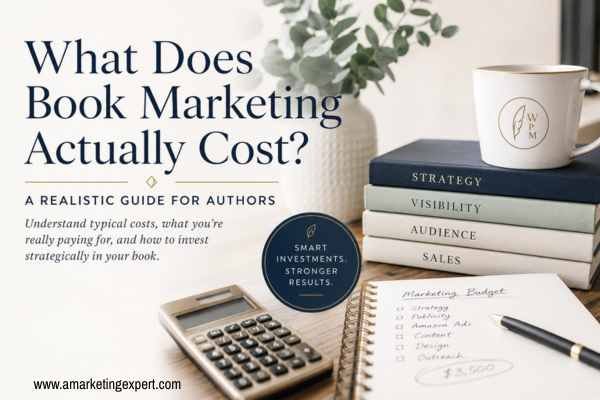
If you have started looking into book marketing, you have probably noticed something quickly: pricing is all over the map.
One company offers a package for a few hundred dollars. Another quotes several thousand. Someone else tells you that you need a publicist, an Amazon ads manager, a social media strategist, a launch team, a website refresh, and a podcast tour—all before your book is even released.
So what does book marketing actually cost?
The honest answer is that it depends on what you need, what stage your book is in, the audience you are trying to reach, and whether you are paying for a one-time promotional activity or a thoughtful strategy designed to support your book over time.
But that answer is only useful if we break it down.
This guide will help you understand typical book marketing costs, why pricing varies so much, what you should reasonably expect at different investment levels, and how to avoid spending money on services that are not right for your book.
The Short Answer: How Much Does Book Marketing Cost?
Book marketing can cost anywhere from a few hundred dollars to $15,000 or more.
That is a broad range because “book marketing” can mean almost anything. It might mean someone runs a few Amazon ads. It might mean a publicist sends out a press release. It might mean a full campaign that includes retail optimization, media outreach, reader outreach, advertising support, influencer strategy, content development, and consulting.
For most authors, a realistic book marketing budget often falls into one of these ranges:
| Type of Support | Typical Cost Range | What It May Include |
|---|---|---|
| DIY education, templates, or tools | $50–$500 | Courses, checklists, marketing plans, software, basic resources |
| Small promotional service | $250–$1,500 | A limited outreach effort, newsletter promotion, basic ads support, or one-off promotional activity |
| Retail optimization or focused strategy | $1,000–$3,500 | Amazon optimization, keyword research, categories, book page recommendations, positioning, launch planning |
| Targeted book marketing campaign | $3,500–$7,500 | Customized strategy, outreach, campaign management, content assets, retail support, visibility planning |
| Comprehensive campaign or long-term support | $7,500–$15,000+ | Multiple coordinated strategies, sustained outreach, advertising, publicity, consulting, and asset development |
These numbers are not rules. They are simply realistic benchmarks to help you understand the marketplace.
The most important question is not, “What is the cheapest book marketing option?”
The better question is:
What am I actually getting for my investment—and will it help this book reach the right readers?
Why Book Marketing Costs Vary So Much
Two book marketing companies can both say they offer “book promotion,” yet provide completely different services.
That is why comparing prices without comparing deliverables can get authors into trouble.
A $500 package and a $5,000 campaign are not necessarily competing offers. They may be solving completely different problems.
Here are the biggest reasons book marketing costs vary.
1. The Type of Marketing You Need
Not every book needs the same kind of support.
A nonfiction author with a strong platform may benefit from media outreach, podcast pitching, and thought-leadership opportunities.
A fiction author may need stronger retail positioning, Amazon optimization, reader outreach, newsletter growth, advertising, and better discoverability before traditional publicity makes sense.
A children’s book may need outreach to educators, librarians, homeschool communities, parenting publications, or literacy organizations.
A business book may need support turning the book into a credibility tool that leads to speaking, consulting, media opportunities, or corporate visibility.
The more specialized the strategy, the more likely the cost will increase.
2. Whether the Work Is Customized or Templated
Some lower-cost services are built around volume.
That is not automatically bad. There are situations where a templated service can be useful. But authors should understand what they are buying.
A lower-priced marketing package may involve a standard press release, a generic list of outlets, a mass email outreach effort, a few social media graphics, or inclusion in a promotional newsletter.
Again, that may be appropriate for certain goals.
But a customized campaign takes more time. It involves reviewing the book, understanding the author’s platform, identifying the actual reader, refining the message, deciding where the book is most likely to gain traction, and building strategies around those realities.
Customization costs more because strategy costs more.
3. The Experience Level of the Team
There is a meaningful difference between hiring someone who has read a few articles about book marketing and hiring a team that has worked across genres, publishing models, retail platforms, media cycles, and author platforms for years.
Experience matters because book marketing is not one-size-fits-all.
A team that understands the difference between marketing fiction and nonfiction, launching a first book versus supporting a backlist, or building visibility for a speaker versus selling a novel can often save you from wasting money on the wrong tactics.
You are not simply paying for activity. You are paying for judgment.
4. Whether You Are Paying for Assets or Just Activity
This is one of the biggest differences in book marketing pricing.
Some marketing activities disappear the moment they are completed.
For example, a single social media post may get a few likes and then vanish into the feed. A one-time email blast may create a small spike and then be over. A press release may be distributed but never meaningfully seen by your ideal reader.
Other investments create assets that can keep working for you.
Examples include:
- A stronger Amazon book page
- Better keywords and categories
- A more compelling description
- A clear positioning statement
- A strong author website page
- Email signup opportunities
- Reader magnets
- Better retailer-facing content
- A strategic media pitch angle
- An improved author bio
- A series or backlist strategy
- Evergreen blog content that helps readers find you
The best marketing investments often give you something that continues to work after the campaign ends.
That does not mean every activity must be permanent to be worthwhile. But authors should be careful about spending most of their budget on temporary visibility with no larger strategy behind it.
5. Advertising Costs Are Often Separate
One area that confuses authors is advertising.
Amazon ads, BookBub ads, Meta ads, and other paid advertising options can be valuable. But ad spend and ad management are usually two different costs.
For example, you may pay a monthly fee to someone who manages your ads, plus the actual advertising budget that goes directly to Amazon, Meta, BookBub, or another platform.
That means a campaign may include:
- Ad strategy
- Campaign setup
- Keyword research
- Ongoing monitoring
- Bid adjustments
- Reporting
- Optimization
But you may still need a separate budget for the ads themselves.
This is important because ads are not magic. If your book cover, description, pricing, reviews, categories, or targeting are not working, spending more money on ads will not solve the underlying issue.
Advertising works best when it supports a solid retail foundation.
What Should Be Included in a Book Marketing Campaign?
This depends on your goals, but a legitimate campaign should be clear about what it includes.
Before signing anything, you should know exactly what you are paying for.
A book marketing campaign may include some combination of:
- Book positioning and audience analysis
- Amazon optimization
- Category and keyword research
- Book description or sales copy recommendations
- Author bio development
- Website or landing page recommendations
- Media outreach
- Podcast outreach
- Blogger or influencer outreach
- Local marketing support
- Library or bookstore outreach
- Email marketing strategy
- Reader magnet strategy
- Advertising strategy or management
- Social media content direction
- Launch planning
- Review strategy guidance
- Reporting and campaign updates
You do not need every service listed above.
In fact, one of the biggest mistakes authors make is assuming that more services automatically equal a better campaign.
The right campaign is the one that addresses your actual gaps.
If your Amazon page is weak, you may need retail optimization before you need ads.
If your book has a clear media angle and you have relevant expertise, you may benefit from publicity outreach.
If you write fiction and have no reader list, you may need to focus on discoverability, retailer positioning, reviews, backlist strategy, and audience-building instead of chasing traditional media.
The goal is not to do everything.
The goal is to do the things most likely to matter.
What Does a Book Publicist Cost?
Book publicity can range from approximately $1,500 to $10,000 or more, depending on the scope of work, the book’s media potential, the level of outreach involved, and whether the publicist is working on a short campaign or a longer-term effort.
A publicist generally focuses on media exposure.
That may include pitching the book or author to:
- Podcasts
- Radio shows
- Online media
- Newspapers
- Magazines
- Blogs
- Digital publications
- Television opportunities
- Influencers
- Industry outlets
- Local media
- Niche communities
But authors should understand that publicity and book marketing are not the same thing.
Publicity can create visibility. It can build credibility. It can give an author content to share. It can support book sales.
But publicity alone does not guarantee sales.
A media mention will not compensate for a weak cover, a confusing book description, poor retailer positioning, no reviews, or a lack of clarity around who the book is for.
This is why a strong campaign often combines visibility-building with retail readiness.
Why Some Book Marketing Campaigns Cost $500 and Others Cost $15,000
This is one of the most common questions authors ask, and it is a fair one.
The difference usually comes down to scope, strategy, customization, time, and team involvement.
A $500 service may include one narrow activity, such as:
- A press release
- A basic promotional email
- A listing in a newsletter
- A limited social media package
- A simple book review outreach effort
- A short consultation
- A one-time Amazon ads setup
A $15,000 campaign may include months of planning and execution, multiple specialists, coordinated marketing strategies, retailer optimization, content development, outreach, reporting, ad management, consulting, and sustained support.
Neither price point is automatically right or wrong.
But authors need to be realistic.
A lower-cost service may be appropriate when you have one very specific need.
A larger campaign may make sense when you are trying to build a platform, launch a serious book initiative, support a business or speaking strategy, revive a backlist, or create visibility that extends beyond one brief promotional window.
The problem is not spending $500.
The problem is spending $500 expecting a $15,000 result.
And the problem is not spending $15,000.
The problem is spending $15,000 without understanding what you are getting, why you need it, or how success will be evaluated.
How Much Should a First-Time Author Spend on Book Marketing?
There is no universal answer, but first-time authors should generally be careful about overspending before they have built the basics.
Before investing heavily in promotion, make sure you have addressed the foundation:
- Is your cover competitive in your genre?
- Does your title and subtitle clearly communicate the book’s value?
- Is your description compelling?
- Are your Amazon categories and keywords strategic?
- Does your author bio make sense for the book?
- Is your pricing appropriate?
- Do you have a clear idea of who the book is for?
- Is your website or author page ready?
- Do you have a way to stay connected with readers after they discover you?
If those things are not in place, a large marketing spend may be premature.
For many first-time authors, a more thoughtful approach is to invest in the strongest foundation first and then build from there.
That could mean starting with retail optimization, a strategy consultation, a launch plan, an email-building effort, or a focused campaign rather than trying to purchase every possible marketing service at once.
How to Set a Realistic Book Marketing Budget
Start by deciding what you need the book to do.
This matters because the right budget depends on the role the book plays in your larger goals.
For example:
If Your Goal Is to Sell More Copies
You may need to focus on retail optimization, ads, reviews, reader outreach, book discovery via influencer outreach, pricing strategy, and audience-building.
If Your Goal Is to Build Your Authority
You may need media outreach, podcast pitching, a stronger website, speaking opportunities, thought-leadership content, and better positioning.
If Your Goal Is to Support a Business
You may need a strategy that connects the book to consulting, speaking, coaching, lead generation, media credibility, or corporate opportunities.
If Your Goal Is to Build a Long-Term Author Career
You may need to think beyond one title and invest in assets that support your next book, your reader list, your series, your visibility, and your long-term discoverability.
Once you know the goal, you can set a budget that makes sense.
A good rule is this:
Do not spend money on marketing because you feel pressured to “do something.” Spend money because you understand what the investment is intended to accomplish.
Red Flags to Watch for When Comparing Book Marketing Costs
There are many excellent people in the book marketing space. There are also plenty of services that sound impressive but offer very little strategic value.
Be cautious if a company:
- Guarantees bestseller status
- Guarantees media coverage
- Guarantees a specific number of book sales
- Cannot explain exactly what they will do
- Uses vague phrases like “maximum exposure” without details
- Promises national television coverage for every book
- Does not ask about your genre, audience, goals, or current platform
- Recommends the same package to every author
- Makes you feel rushed or pressured
- Cannot explain what happens after the campaign ends
- Talks only about activity and never about results, assets, or long-term strategy
- Offers a huge list of media contacts but cannot explain why those contacts are relevant to your book
A good marketing partner should be able to explain the strategy in plain English.
You should not need a decoder ring to understand what you are buying.
Is Hiring a Book Marketing Company Worth It?
It can be—but only when the service matches the book, the author, and the goal.
Hiring help is often worth it when:
- You do not have time to learn and execute every aspect of book marketing yourself
- You are unsure where to focus
- Your book is not getting traction and you need an outside perspective
- You have a strong book but weak retail positioning
- You want to build a better long-term marketing foundation
- You need help reaching readers, media, influencers, bookstores, libraries, or niche communities
- You are launching a book that supports your business, speaking, consulting, or brand
- You are tired of trying random tactics without a plan
It may not be worth it when:
- Your book is not yet professionally ready
- Your cover or positioning needs work
- You expect marketing to fix a book that readers are not responding to
- You have no clear goals
- You are looking for a guaranteed shortcut
- You are not prepared to participate in the process
- You have a very limited budget but need a large, customized campaign
Marketing works best when the author and marketing team are working toward a shared goal.
Final Thoughts: Spend Strategically, Not Emotionally
Book marketing can be confusing because authors are often presented with an overwhelming list of things they are told they “should” be doing.
Ads. Publicity. Social media. Reviews. Podcasts. Bookstores. Influencers. Amazon. Email lists. Events. Blogs. Video. Local outreach.
The truth is, you do not need to do all of it.
You need to understand where your book is today, what is holding it back, who the right readers are, and what kind of visibility would actually make a difference.
The best book marketing investment is not always the largest one.
It is the one that helps you make better decisions, build stronger assets, reach the right audience, and create momentum that can continue after the initial campaign is over.
Before hiring anyone, ask what the service is designed to do, what is included, how it supports your larger goals, and what you will have when the work is complete.
That is how you make a smart marketing investment instead of simply buying more activity.
Frequently Asked Questions About Book Marketing Costs
How much does book marketing cost?
Book marketing can cost anywhere from a few hundred dollars for a limited promotional service to $15,000 or more for a comprehensive campaign. Most authors should expect the cost to vary based on the services included, how customized the work is, the length of the campaign, and whether advertising spend is separate.
How much does a book publicist cost?
A book publicist may cost roughly $1,500 to $10,000 or more, depending on the type of outreach, campaign length, media targets, and the publicist’s experience. Publicity focuses on gaining media exposure, but it should usually be part of a broader marketing plan rather than the entire strategy.
Is book marketing worth the money?
Book marketing can be worth the investment when the strategy fits your goals and your book is ready for promotion. It is less effective when authors spend money before addressing foundational issues such as cover design, book positioning, retailer optimization, pricing, reviews, or audience clarity.
Why are some book marketing services so cheap?
Lower-cost services are often narrower, more standardized, or designed to serve many authors at once. They may provide a specific promotional activity rather than a customized marketing strategy. That does not make them inherently bad, but authors should be clear about what they are receiving and what results are realistic.
Do I need to spend thousands of dollars to market my book?
No. You do not need to spend thousands of dollars to begin marketing your book. Many authors can make meaningful progress by improving their book page, clarifying their audience, building an email list, strengthening keywords and categories, and focusing on a few high-value marketing priorities. Larger investments make more sense when they align with larger goals and a clear strategy.
Are Amazon ads included in book marketing costs?
Sometimes. However, ad management fees and actual ad spend are often separate. You may pay a marketing company to manage Amazon ads while also funding the advertising budget directly through Amazon. Always ask whether ad spend is included in a quoted price.
What should I ask before hiring a book marketing company?
Ask what is included, what the strategy is designed to accomplish, how the company approaches your genre and audience, whether the work is customized, what assets you will have after the campaign, how progress will be reported, and what results are realistic. Be cautious of guarantees related to bestseller status, media coverage, or sales.
What is the best way to budget for book marketing?
Start with your goals. Decide whether your priority is sales, visibility, authority, lead generation, reader growth, launch support, or long-term career building. Then invest in the areas most likely to support that goal. Avoid spending money simply because a service sounds impressive or because you feel pressure to do everything at once.
The Right Marketing Strategy Depends on Your Goals
After more than 25 years working with authors, we’ve learned that there are very few one-size-fits-all answers in book marketing. What works for one book may not work for another, and the key is understanding where to focus your time, energy, and resources for the greatest impact.
If you’d like more practical insights, subscribe to the Book Marketing Tips & Author Success Podcast, where we share honest conversations about publicity, platform building, book promotion, and what’s actually working for authors today.
If you’re ready for a more personalized discussion about your book and your goals, contact Author Marketing Experts. We’d be happy to learn more about your book and help you determine which marketing strategies make the most sense for your publishing goals.
I have two children’s books published and live on Amazon and Barnes and Noble. The one book is on 20+ platforms. They are called ‘What If There Were No Christmas?’ and ‘Best of Friends’. I went through a publishing company that does not do the marketing. So I did my own marketing through media outlets, like Facebook, Zeely, donating copies to schools and local libraries.
However, for my Christmas, I went through a traditional publishing company KDP, not the one owned by Amazon, this one is Kintric Digital Publishing. They do marketing, I did get the book I paid for, I also paid $1000 for extra marketing, which extended my budget, I recieved little attention.
Now, I am being offered a marketing package for $3200. Should I spend the money and take a chance?
Debbie we’re going to reach out directly, we’d love to chat about what makes the most sense for both your goals and budget. Customization is key, don’t settle for anything less.