
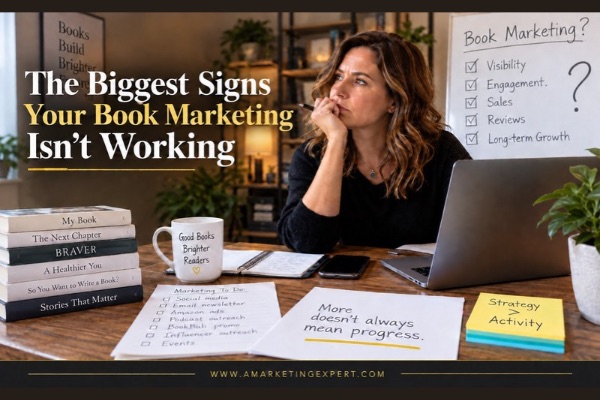
One of the hardest things about book marketing is knowing when to keep going—and when to admit that something isn’t working.
Because not only does marketing take time, but it can also feel wildly confusing. The options for book marketing are endless. So how do you know if your book promotion isn’t working? Let’s unpack this.
First off, readers don’t see a post, an ad, a podcast interview, or an Amazon page and immediately buy. More often than not, it can take several encounters with you or your book before they decide it’s worth their money—and, maybe more importantly, several hours of their time. Consider the rule of seven – it takes seven impressions to make a sale. And in a world full of distractions, I would guess that that number is even higher. At the same time, a quiet sales week doesn’t automatically mean your marketing strategy has failed.
But there’s a big difference between marketing that needs time to build momentum and marketing that is simply generating activity aka noise without moving your book forward. Because after more than 25 years of working with authors, I can tell you that the warning signs tend to be remarkably consistent and easy to spot. When authors come to us they almost always want a new campaign, but lurking behind that request is also the need for a second opinion, which is fair. Because it’s hard to know if you’re doing the right things.
Their problem isn’t necessarily that they aren’t doing enough marketing. Quite often, they’re doing plenty. They’re just doing the wrong things—or trying to market a book whose foundation isn’t ready to support all that visibility.
So if you’re wondering whether your book marketing is really working, here are the signs I’d pay attention to.
First: What Does “Book Marketing Is Working” Actually Mean?
Before we diagnose the problem, we have to define success. Because one of the biggest mistakes authors make is using book sales as the only measurement of whether marketing is working.
And yes, sales matter. Obviously.
But smart book marketing also looks at other metrics. For example:
- Discoverability
- Reader awareness
- Retail credibility
- Reviews
- Email subscribers
- Media opportunities
- Podcast appearances
- Influencer or reviewer relationships
- Search visibility
- Amazon visibility
- Author authority
- Repeat exposure to the right audience
Good marketing creates signals and over time, those signals should begin reinforcing one another. If none of that is happening—if six months into your marketing you’re basically in exactly the same position you were when you started—that deserves a closer look. So yes, sales matter but sales as the primary metric is not a good way to measure the success of your book marketing.
1. You’re Doing a Lot, But Nothing Seems Connected
This is one of the first things I notice when reviewing an author’s marketing. They’re posting on Instagram. They’re running Amazon Ads, pitching podcasts, sending newsletters, trying TikTok, running discounted eBook promotion and maybe even taking a stab at trying out some BookBub ads.
Individually, none of those things is necessarily wrong. The problem is that there’s no connective tissue between them meaning they aren’t connected in any cohesive way through messaging, timing, or a plan. Book marketing shouldn’t feel like pulling tactics randomly out of a hat, a strong campaign should be able to answer three basic questions:
Who am I trying to reach?
Why should this particular reader care about my book? (and yes, I know that’s often a tough one for authors)
What am I doing to repeatedly put the book in front of the right reader?
If you can’t answer those questions, you probably don’t have a marketing strategy. Instead you probably have a collection of marketing activities you randomly execute and sadly, that’s not going to move the needle.
2. Your Marketing Keeps Sending People to a Weak Amazon Page
This one is a big yikes for me and, sadly, one I see a lot of.
Authors will sometimes spend hundreds or thousands of dollars generating visibility while overlooking the place where most readers ultimately make the buying decision: Their Amazon page.
Marketing creates curiosity and your retail page has to convert that curiosity into confidence.
That means your:
- Cover
- Book title and subtitle
- Book description
- Editorial reviews
- Reader reviews
- Author bio
- A+ Content
- Categories
- Keywords
- Overall positioning
All of these pieces need to work together.
If your marketing is successfully getting someone to Amazon but the retail page makes the book look confusing, amateurish, dated, or indistinguishable from dozens of competing titles, increasing traffic won’t solve the problem. In fact it can actually make an existing conversion problem more expensive.
This is one of those situations where a good book marketing consultant may recommend doing less promotion temporarily while strengthening the page everything else is pointing toward.
And yes, I know that can feel counterintuitive. But there is very little value in sending more people to something that isn’t converting.
3. You Can’t Clearly Explain Who Your Reader Is
If your answer is:
“Women.”
“People who like mysteries.”
“Anyone interested in personal growth.”
“Parents.”
“History buffs.”
You probably still have some work to do. Because good audience targeting goes deeper. For example:
What does this reader already read?
What other authors do they follow?
What problem are they trying to solve?
What emotional experience are they looking for?
What communities are they part of?
What words do they use when they search for books like yours?
What would make them choose your book instead of ten similar books?
This has become even more important as discovery becomes increasingly AI-driven.
Readers aren’t only typing short keyword phrases into search boxes anymore. They’re asking increasingly detailed questions and expecting Amazon, Google, ChatGPT, and other AI-powered tools to help them narrow the options. And yes keywords still matter, but good/focused keywords matter more.
Instead of:
books about aging
someone may ask:
What are some encouraging books for women over 50 who want to rethink aging and build a more meaningful next chapter?
Or instead of:
Irish travel books
they might ask:
What are some funny, personal books about traveling through Ireland that combine culture, history, golf, and storytelling?
That changes the discovery equation.
Your book needs enough contextual clarity online for search engines, retailers, and AI tools to understand who the book is for, what it offers, and when it should be recommended.
If your marketing still boils your book down to vague language like “an inspiring story everyone will love,” you’re making that job much harder.
4. Your Messaging Could Describe 500 Other Books
This is closely related and again, hard for authors to hear – I know. But stay with me because I promise this will help you. Start by pulling up your website, your Amazon description, and your recent social media posts.
Now remove your book title.
Could the copy describe hundreds of other books in your category? If so, you have a positioning problem.
Words like:
- Inspiring
- Heartwarming
- Life-changing
- Gripping
- Powerful
- Unforgettable
- Transformational
aren’t inherently bad.
But they don’t tell readers very much. And marketing built around generic adjectives becomes increasingly invisible in a crowded marketplace.
A book marketing expert should be able to identify what makes your book distinctive and then make sure that distinction appears consistently across your retail page, website, outreach, metadata, content, and promotional messaging.
Because if you can’t articulate your difference, your reader probably can’t either.
5. You’re Getting Visibility—but It’s the Wrong Visibility
This can be particularly deceptive because the numbers sometimes look good but the wrong numbers, sadly, won’t matter to your visibility. So maybe a Reel got 20,000 views or a giveaway attracted 3,000 entries. An Instagram post got hundreds of likes.
Terrific.
But what happened next?
Did the audience care about books like yours?
Did people visit your website?
Did they look at the book?
Did they join your email list?
Did you gain reviews, followers, clicks, saves, retailer traffic, or any other meaningful reader signal?
Visibility is not inherently valuable.
Relevant visibility is.
I’d rather put a niche nonfiction author in front of 800 people who are deeply interested in the subject than 80,000 people who aren’t.
The same goes for fiction.
A romance author doesn’t need every reader.
They need romance readers—and ideally readers of that specific romance subgenre, trope, tone, or reading experience.
If your marketing reports are filled with big numbers but none of those numbers seem connected to actual reader behavior, look closer.
6. Nobody Ever Changes the Strategy
Marketing isn’t something you create once and then blindly execute for the next six months.
Good campaigns evolve. We test, we learn, we watch and listen to the reader signals – i.e. what they respond to – and we see which pitches generate the most interest. We also watch retail behavior and we examine which messaging resonates.
Then we adjust. We pivot. We remain flexible because the only thing that matters are the readers.
One of the biggest warning signs I see is a campaign that continues doing exactly the same thing despite consistently weak results.
More pitches.
More posts.
More ads.
More emails.
Same strategy.
A strategy isn’t good simply because somebody put it into a beautiful proposal. The market gets a vote.
If the market is telling you something isn’t connecting, listen.
7. Your Marketing Team Reports Activity Instead of Insight
This deserves particular attention if you’ve hired someone to help market your book.
There is a huge difference between:
“We sent 150 pitches this month.”
and:
“We’re seeing stronger interest when we lead with this angle, so we’re shifting our outreach toward these three audience segments.”
One is an activity report.
The other is strategy.
Likewise:
“We posted 20 times.”
isn’t nearly as useful as:
“These three topics are consistently generating saves and clicks, suggesting that this reader concern is resonating. We recommend expanding it.”
You should understand not only what your marketing team is doing, but what they are learning.
Because experienced marketing isn’t just execution.
It’s interpretation.
8. Your Entire Strategy Depends on One Big Break
This happens constantly and it’s a huge pitfall.
“If I can just get on a major podcast…”
“If an influencer picks it up…”
“If my TikTok goes viral…”
“If I can get national media…”
“If Oprah notices it…”
A big break would be lovely. But a hope is not a marketing plan.
Strong book marketing creates multiple paths to discovery.
- Amazon
- Search
- Media
- Podcasts
- Reader recommendations
- Influencers
- Libraries
- Bookstores
- Events
- Local opportunities
- Author platforms
- AI-powered discovery
No single channel has to carry the entire book. This matters because the strongest author platforms tend to become ecosystems.
Someone hears you on a podcast then they Google you, or go to your website (you have an author website, right?). They visit Amazon and see your strong retail page and reviews. Then they encounter you again somewhere else.
Then they buy.
That’s how reader confidence builds.
9. You’re Chasing New Platforms While Ignoring Existing Problems
There will always be a shiny new marketing opportunity for a while it was Booktok, and everyone wanted to be part of that viral trend. And yes it’s fun and if that’s where your audience is, give it a shot. But only if it makes sense. Because there will always be a new social platform, or new Amazon ad format, a new cool AI tool, or a new algorithm someone claims you need to master immediately.
But sometimes the answer isn’t adding another tactic.
Sometimes the answer is fixing what’s already there.
I see authors asking:
“Should I start using this new platform?”
when the more important questions are:
- Is your Amazon page converting?
- Is your book positioned correctly?
- Do you know your audience?
- Does your website clearly communicate what you write?
- Can people find you in search?
- Does your messaging sound different from competing books?
- Are you building an email list?
- Do you have a way to stay connected to readers who discover you?
Fix those before you add another account you’re going to feel obligated to maintain.
10. You Have No Idea What You’ve Learned From Your Marketing
This may be the biggest one. Even marketing that doesn’t produce the results you hoped for should teach you something.
And maybe one audience responded much better than another.
Maybe a particular hook consistently gets attention.
Maybe podcast listeners convert better than social followers.
Maybe certain ad copy performs better.
Maybe your cover is getting clicks but your page isn’t converting.
Maybe readers love a theme you barely mention in your marketing.
Marketing produces information.
If you’ve been actively promoting your book for months and can’t name one thing you’ve learned about your readers, messaging, positioning, or marketplace, something is missing.
When Should You Get a Second Opinion on Your Book Marketing?
Not every disappointing month means you need to hire someone.
But there are situations where bringing in a book marketing consultant or experienced book marketing expert can save you a significant amount of time and money.
Consider getting another perspective if:
- You’ve been consistently marketing for several months with little measurable movement.
- You’re spending money on ads but can’t tell whether they’re helping.
- You’re getting traffic but very few sales.
- You’re overwhelmed by conflicting marketing advice.
- You’re doing many promotional activities but don’t know which ones matter.
- Your marketing company can’t clearly explain the strategy behind its work.
- Your book has strong reviews but struggles to attract new readers.
- You’re preparing to spend significantly more money and want to know whether the foundation is ready.
- You’ve tried multiple tactics and feel like you’re starting over every few weeks.
- You suspect the real problem may be positioning, packaging, or your Amazon page rather than promotion itself.
Sometimes a second opinion confirms you’re heading in the right direction and simply need more time.
Sometimes it uncovers one or two issues holding everything else back.
And sometimes it reveals that the current strategy needs to change substantially.
All three answers are valuable.
What Should a Book Marketing Expert Look At?
A useful marketing assessment shouldn’t start with:
“Here are 15 more things you should be doing.”
It should start with diagnosis.
When we’re evaluating why marketing isn’t performing the way an author hoped, we look at the entire reader journey:
Discovery ? Interest ? Confidence ? Purchase ? Ongoing Reader Relationship
Where does that journey break down?
Can readers find the book?
If they find it, does the positioning make sense?
Does the packaging create interest?
Does the retail page reinforce the promise?
Are there enough confidence signals?
Is the author reaching the right audience?
Does the outreach match the book?
Is the book visible for the searches and conversations where it should naturally appear?
Can search engines and AI-powered discovery tools clearly understand the book, author, topic, audience, and authority behind it?
That’s a very different exercise from simply recommending more promotion.
The Bottom Line: Don’t Confuse Motion With Momentum
Authors are under enormous pressure to keep doing more.
Post more.
Pitch more.
Advertise more.
Create more content.
Join another platform.
Make another video.
But more marketing is not always better marketing – sometimes it’s just more.
If the foundation is wrong, more promotion magnifies the problem.
If the audience is wrong, more visibility reaches more of the wrong people.
If the positioning is vague, more messaging repeats the same vague message.
And if nobody is learning from what’s happening, the campaign becomes activity for activity’s sake.
Sometimes the smartest next marketing move isn’t another tactic.
It’s figuring out why the tactics you’re already using aren’t producing the signals they should.
And that’s exactly when getting a second opinion can change everything.
Quick Answer: How Do You Know If Your Book Marketing Isn’t Working?
Your book marketing may need a second look if you’re consistently promoting the book but seeing little improvement in relevant visibility, reader engagement, retailer traffic, reviews, audience growth, discoverability, or sales—and you can’t clearly explain what the campaign is learning or changing as a result.
Effective book marketing should do more than generate activity. It should progressively improve how the right readers discover, understand, trust, and ultimately choose your book.
A qualified book marketing consultant or book marketing expert should help identify where that process is breaking down before recommending that you simply spend more money or do more marketing.
Frequently Asked Questions About Book Marketing
How long should I try book marketing before deciding it isn’t working?
There is no universal timeline because books, audiences, author platforms, budgets, and marketing strategies vary enormously. However, within several months of consistent marketing you should generally be seeing useful signals—greater visibility, audience growth, engagement, retail traffic, reviews, media interest, stronger advertising data, or clearer insights into what resonates. If nothing is changing and nothing is being learned, it’s worth reassessing the strategy.
What does a book marketing consultant do?
A book marketing consultant evaluates your book’s positioning, audience, retail presence, discoverability, promotional strategy, and reader journey to identify where your marketing may be underperforming. The best consultants diagnose the problem before recommending additional tactics or spending.
What’s the difference between a book marketing consultant and a book marketing expert?
The terms often overlap. A book marketing consultant typically provides strategic evaluation and recommendations, while a book marketing expert may provide consulting as well as campaign execution. What’s more important than the title is demonstrated experience with books, authors, retail platforms, reader behavior, and current discovery channels.
Does poor book sales mean my marketing isn’t working?
Not necessarily. Book buying often involves multiple touchpoints, and marketing can create valuable visibility and reader-confidence signals before they appear in sales data. However, consistently weak sales combined with little growth in visibility, engagement, reviews, traffic, discoverability, or audience can indicate a larger strategic problem.
Should I spend more on marketing if my book isn’t selling?
Not until you understand why the current marketing isn’t converting. Increasing visibility can be useful when your positioning, packaging, audience targeting, and retail page are strong. If those elements aren’t working, additional spending may simply send more people into a weak sales funnel.
When should I get a second opinion on my book marketing?
Consider a second opinion when you’ve been marketing consistently without meaningful progress, you’re receiving conflicting advice, you’re spending money without understanding the return, or your current marketing provider cannot clearly explain what’s working, what isn’t, and how the strategy is changing in response.
Stop Waiting for the Perfect Time to Market Your Book
A book doesn’t build momentum simply because it deserves an audience.
Reviews require outreach. Visibility requires activity. Reader relationships require consistency. And sales usually require many interconnected pieces working together over time.
You don’t need to tackle everything today. You do need to stop waiting for motivation, certainty, or the perfect marketing opportunity before you begin.
Figure out who your reader is. Strengthen the places where purchasing decisions happen. Choose one meaningful action.
Then do it.
Want more practical strategies for building your audience and selling more books? Subscribe to the Book Marketing Tips & Author Success Podcast for straightforward advice on what’s working in book marketing now.
And if you’re tired of wondering what you should be doing next, contact Author Marketing Experts to learn how we can help you identify the right priorities and build a smarter marketing strategy for your book.
“`
Hello,
Thank you for sharing your insightful thoughts.
I promoted my 9 books mystery series amazon translated editions with kdp select 5 days free promotions spanning for 10 days. Free downloads are 1700 and sales are 25 units with around 800 ku pages. this is during the promotion period. No reviews yet. Do you think it is an acceptable results? Thanks for your thoughts.